MEXICO
Capital: Mexico City | Population: 132 million
Lead bodies for sport development: National Commission for Physical Culture and Sport (CONADE)

| Government Support | C |
| Elite Sport Rank | 31 |
| Elite Sport Rank Per Capita | 68 |
| Youth Sport Participation Grade | D- |
Unlike the U.S. model, Mexico uses a centralized governance system. CONADE is the leading government agency, established by the General Law of Physical Culture and Sport (LGCFD) as a decentralized body of the Secretariat of Public Education (SEP) [3]. CONADE is responsible for proposing national sports policy and managing the federal budget, acting as the bridge between the federal government and national sports associations.
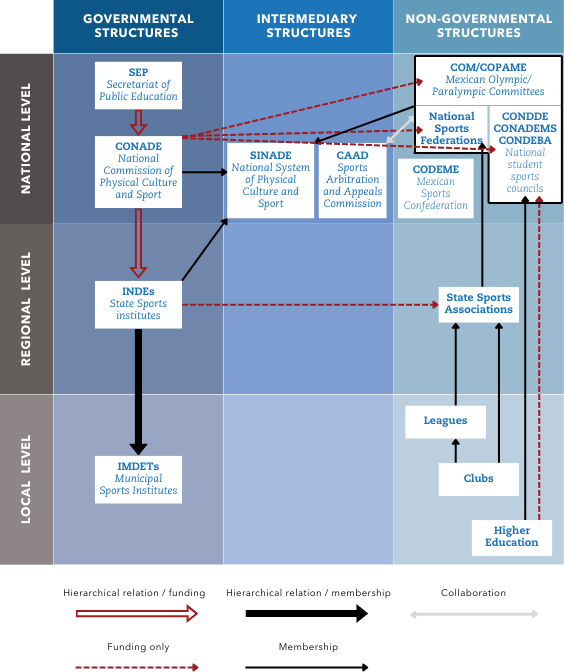
The Mexican system is a mixed model with strong state dependence. The National System for Physical Culture and Sport (SINADE) acts as the supreme collegiate body, bringing together CONADE, the Mexican Olympic Committee (COM), and the presidents of the National Sports Federations [3]. Although the Federations are legally “Civil Associations” (private non-profit entities), the LGCFD requires that, to receive public funding and represent Mexico internationally, they must obtain a Unique Sports Registration (RUD) from the National Registry of Physical Culture and Sports (RENADE) overseen by CONADE. This creates a vertical power structure where federal funding dictates the viability of programs. At the subnational level, each of the 32 states has its own State Institute of Sport (INDE), which replicates CONADE’s structure and is critical for talent detection.
The current national strategy, “Institutional Program 2025-2030,” is derived from the National Development Plan. For the current fiscal year, the Operational Rules of the 2025 Physical Culture and Sport Program establish the criteria for distribution of subsidies, prioritizing transparency and direct delivery of resources to athletes, aiming to reduce intermediaries [4]. The strategy faces the dual challenge of “massification” (increasing physical activity to combat the high obesity rates reported in the 2022 report card [1]) and “high performance.”
Mexico has a massive talent detection engine driven by the states: the CONADE National Games. Each year, state governments invest their own resources to recruit and train young athletes to compete in this national championship, following CONADE’s technical guidelines [4]. It is a system that encourages local governments to directly fund youth sport, serving as the main “talent pool” for national teams.
Government funding is the cornerstone of Mexican sport. According to the Opinion of the Sports Commission on the 2025 Federal Expenditure Budget, the allocation for sector 11 (Physical Culture and Sport) is $2,637,738,175 pesos [5] (~$130M USD). Historically, this budget has fluctuated significantly. For the 2026 fiscal year, the Expenditure Budget maintains the program structure to ensure the operation of key facilities such as the National Center for the Development of Sports Talents and High Performance (CNAR) [6]. Unlike countries such as Norway or the United Kingdom, Mexico lacks a dedicated funding flow from the National Lottery; resources come directly from general tax revenue.
Mexico currently does not have an independent “Safe Sport” agency, such as Canada’s Office of the Sport Integrity Commissioner. Instead, safeguarding depends on the Protocol for the Prevention, Attention, and Sanctioning of Sexual Harassment and Sexual Assault, a federal decree applicable to the entire public administration, including CONADE [7]. Although the law contemplates sports justice mechanisms like the Sports Appeal and Arbitration Commission (CAAD), the implementation of this protocol is the main defense mechanism for athletes in cases of abuse within public facilities.
Sport Governance in Mexico
GLOSSARY
GOVERNMENTAL STRUCTURE (Public Sector)
SEP (Secretariat of Public Education): This is the State Secretariat to which sports are assigned. It acts as the “sector head,” channeling the federal budget (Budget Line 11) and aligning sports with national educational policies, although it does not intervene in day-to-day sports operations.
CONADE (National Commission of Physical Culture and Sport): The lead body, its a decentralized public body responsible for formulating national sports policy, managing the federal budget, granting subsidies to federations, and coordinating SINADE.
INDEs (State Sports Institutes): These are the lead agencies at the regional level (in all 32 states). They operate with their own state budgets and federal subsidies. They are a key piece for talent development through the CONADE National Games.
IMDETs (Municipal Sports Institutes): The authority at the local level. Their main function is to promote mass physical activity, social sports, and the maintenance of basic sports infrastructure in municipalities.
INTERMEDIARY AND JUDICIAL STRUCTURES
SINADE (National System of Physical Culture and Sport): The highest collegiate governance body. Chaired by CONADE, it functions as an assembly that brings together representatives from the government, the Olympic and Paralympic Committees, and the federations to establish national coordination agreements.
CAAD (Sports Appeal and Arbitration Commission): The highest sports justice tribunal. Although decentralized from SEP, it operates autonomously to resolve disputes between athletes, coaches, and federations, acting as the final national instance before civil courts.
NON-GOVERNMENTAL STRUCTURES
COM/COPAME (Mexican Olympic Committee/Mexican Paralympic Committee): Autonomous organizations recognized by the IOC/IPC. They have exclusive authority to enter the Mexican delegation in the Olympic, Pan American, and Central American Games. They safeguard the Olympic Charter and operate independently from the government, although they collaborate technically.
National Sports Federations: Private civil associations that serve as the highest technical authority for each sport (e.g., Mexican Football Federation, Athletics, etc.). They are responsible for regulating their sport, forming national teams, and organizing national championships.
CONDDE, CONADEMS, CONDEBA (National Student Sports Councils): Organizations in charge of coordinating school and university sports.
CODEME (Mexican Sports Confederation): Historically the umbrella organization for federations. It currently functions as a civil association that groups various federations, acting as a consultative body and defender of federative interests, although without the governing powers it once had.
State Sports Associations: Operational arms of the National Federations in each state. They work together with the INDEs to regulate competitive sports at the regional level.
Clubs and Leagues: The base of the private pyramid. Local entities (for- or non-profit) where daily sports practice, initiation, and primary talent detection take place.
References
Population estimate from CONAPO 2026. Youth Sport Participation grade from the 2022 Mexican Report Card on Physical Activity for Children and Adolescents, based on the finding that less than 20% of young people meet international physical activity guidelines. Government Support grade from expert analysis based on the centralized structure established by law, but limited by recent budget stagnation reflected in the Opinoin of the Sports Commission on the Federal Expenditure Budget Project FY 2025. Elite Sport Ranking and Elite Sport Ranking Per Capita from Greatest Sporting Nation (2025 Global Cup), based on aggregated results in international competitions and adjusted for population size.
[1] Argumedo, G., et al. (2024). Results from the 2022 Mexican Report Card on Physical Activity for Children and Adolescents. Frontiers in Pubic Health/Active Healthy Kids Global Alliance.
[2] Greatest Sporting Nation. (2025). Global Cup Ranking 2025. www.greatestsportingnation.com.
[3] Cámara de Diputados del H. Congreso de la Unión. (2025). Ley General de Cultura Física y Deporte (LGFCD). Última Reforma DOF 14-11-2025.
[4] Secretaría de Educación Pública (SEP). (2025) Acuerdo número 01/02/25 por el que se emiten las Reglas de Operación del Programa de Cultura Física y Deporte para el ejercicio fiscal 2025.
[5] Comisión de Deporte de la Cámara de Diputados. (2024). Opinión de la Comisión de Deporte al Proyecto de Presupuesto de Egresos de la Federación para el Ejercicio Fiscal 2025. LXVI Legislatura.
[6] Presidencia de la República. (2025). Presupuesto de Egresos de la Federación para el Ejercicio Fiscal 2026. Diario Oficial de la Federación.
[7] Secretaría de Gobernación/INMUJERES. (2020). Protocolo para la prevención, atención y sanción del hostigamiento sexual y acoso sexual. Diario Oficial de la Federación.