

Photos: Portland Tennis & Education (L), Youth on Course (R)
Everyone knew that COVID would scramble the youth sports landscape. We just didn’t know which sports might suffer and which might experience a bump. Several years of youth sports participation data have now answered that question and the big winners are golf and tennis.
That’s what the latest release of data from the Sports & Fitness Industry Association and other organizations makes clear. Tennis and and golf experienced rises at both the entry level and through adolescent years, according to separate data shared by the U.S. Tennis Association and National Golf Foundation. Soccer and flag football also rebounded well from the historic disruption caused by the pandemic, with most of that growth among younger children.

The Aspen Institute’s Project Play initiative is transitioning from its annual National State of Play report to real-time analysis of youth sports data. Instead of waiting until the end of the year for a single report combining multiple sources, Project Play will publish insights as new data becomes available to provide more timely research in support of your work.
Each year, Aspen uses SFIA data to analyze the sports ecosystem as part of its Project Play initiative focused on building healthy children through sports. The SFIA data is from 2025 and drawn from a national survey of 18,000 online interviews by Sports Marketing Surveys. The SFIA data is one measure Aspen uses to analyze the sports ecosystem as part of its Project Play initiative focused on building healthy children through sports.
The SFIA data represents the most recent snapshot of sport activity, and supplements data that Aspen analyzes from the National Survey of Children’s Health (NSCH). The NSCH, conducted by the U.S. Census Bureau, surveys a larger sample of parents annually (about 37,000 in 2024) and offers state-by-state breakdowns, but has a two-year lag in the release of its data and does not offer sport-by-sport breakdowns. The most recent data is from 2024, which showed 58% of youth ages 6-17 played on a team or took sport lessons in the past year.
- Tennis and golf surge with help of new formats
- Flag football keeps growing
- Soccer and baseball face retention challenges
- SFIA data suggests continued progress against 63X30 goal
- Low-income kids are being left behind as costs rise
- Girls play more often, and boys’ participation starts to recover
- Asian youth participation rates skyrocket — unlike Black youth
- Fewer adults are coaching
- Training for coaches has decreased
1. Tennis and golf surge with help of new formats
Aspen annually tracks SFIA core participation, meaning children who played sports on a regular basis. Between 2019 – the year before COVID hit – and 2025, tennis’ core participation increased by 72% among youth ages 6-12 and by 46% for ages 13-17.
What’s fueling this growth? According to the USTA, youth who started playing tennis in the past year were motivated to join because they:
Heard about the health benefits
Were looking for a new way to socialize
Wanted to be part of a community
Heard a lot about tennis
Saw tennis in pop culture
Saw fashion trends around tennis
Played another racquet sport
Participation in tennis among all ages has grown for seven consecutive years, even with, or perhaps aided by, the rise of pickleball. Eight in 10 tennis players plan to continue playing recreationally after they are done with organized tennis, according to USTA research.
“Knowing that coaches are the most impactful influence on the youth tennis experience, USTA Coaching has also invested in making sure there are more quality coaches to deliver positive experiences,” said Craig Morris, CEO of USTA Coaching, and a member of the 63X30 roundtable of national organizations that Aspen convenes to get more kids playing sports..
Meanwhile, golf’s core participation from 2019 to 2025 increased by 33% among youth ages 6-12 and 36% for ages 13-17. Golf surged during the pandemic and has sustained that growth through efforts to redefine how people first experience the sport.
“The industry has made a concerted and focused effort to grow junior golf with programs like PGA Jr. League, Drive, Chip and Putt, First Tee, Youth on Course, Operation 36, Girls Golf and more,” said Steve Tanner, PGA senior director of player engagement and a member of the Aspen Institute’s 63X30 roundtable. “Additionally, many PGA Sections offer junior tours that create pathways for kids to develop and grow with the sport. While we should be proud of growing the sport to 4 million youth, the reality is that this returns the sport to similar levels as the early 2000s.”
Who’s playing golf is dramatically changing. According to the PGA, girls currently represent 35% of junior golfers and minorities represent 26% of them. That’s significantly higher than 20 years ago when girls comprised 15% of junior golfers and minorities represented 6%. New programs are helping to drive these shifting demographics.
“The image of golf before COVID was that it’s a sport for only old people and mostly males,” said Emily Denes, director of development at First Tee – Phoenix. “It’s quite a transition for golf from what it used to be.”
More golf courses have adjusted from 18 holes to shorter rounds, recognizing that not everyone wants to play for many hours. Night golf gained popularity with par-3 courses and music playing to attract younger people. Putting courses emerged for those interested in only their short game. And technology has fueled interest, such as indoor golf simulators, tracer technology on driving ranges showing how far and fast a ball was hit, and venues like Topgolf and PopStroke offering informal golf games using tech.
“In the last couple years, you see with kids on social media, it’s kind of hip or cool to be involved with golf,” said Scott McNevin, executive director of the Junior Golf Association of Arizona. “You see a lot more celebrities golfing, like LeBron James has a YouTube channel where he’s golfing. It’s a lot different than it used to be and a lot more kids want to get involved in the game.”


2. Flag football keeps growing
Among children ages 6-12, soccer core participation increased 7% from 2019 to 2025 — even prior to any potential bump from the U.S. co-hosting the 2026 FIFA Men’s World Cup. Soccer’s domestic profile has built steady momentum following Lionel Messi’s 2023 MLS debut, the 2024 Copa América and the 2025 FIFA Club World Cup.
“This is the single best moment in time for soccer to grow in the U.S.,” said Alex Kerman, SFIA senior director of research operations and business development.
Major League Soccer’s launch of MLS GO in 2023 established an accessible recreational-level entry point for kids ages 4-14 at lower costs than traditional travel clubs. However, pay-to-play travel models continue to dominate the youth soccer landscape, functioning as a commercialized system that frequently excludes lower-income children. In August 2026, the U.S. Youth Soccer Association voted to essentially hand control of its organization over to the U.S. Soccer Federation, a move that some view as a significant step toward reform in soccer.
Flag football also continued its rapid growth, posting five-year increases of 30% among kids ages 6-12 and 15% among teens ages 13-17. Over the same period, youth tackle football declined 6% for ages 6-12 and remained flat for ages 13-17.
“We haven’t seen any data that has said flag is a deterrent to tackle,” Kerman said. “Flag seems to be just adding to the number of children playing any form of football.”
3. Soccer and baseball face retention challenges
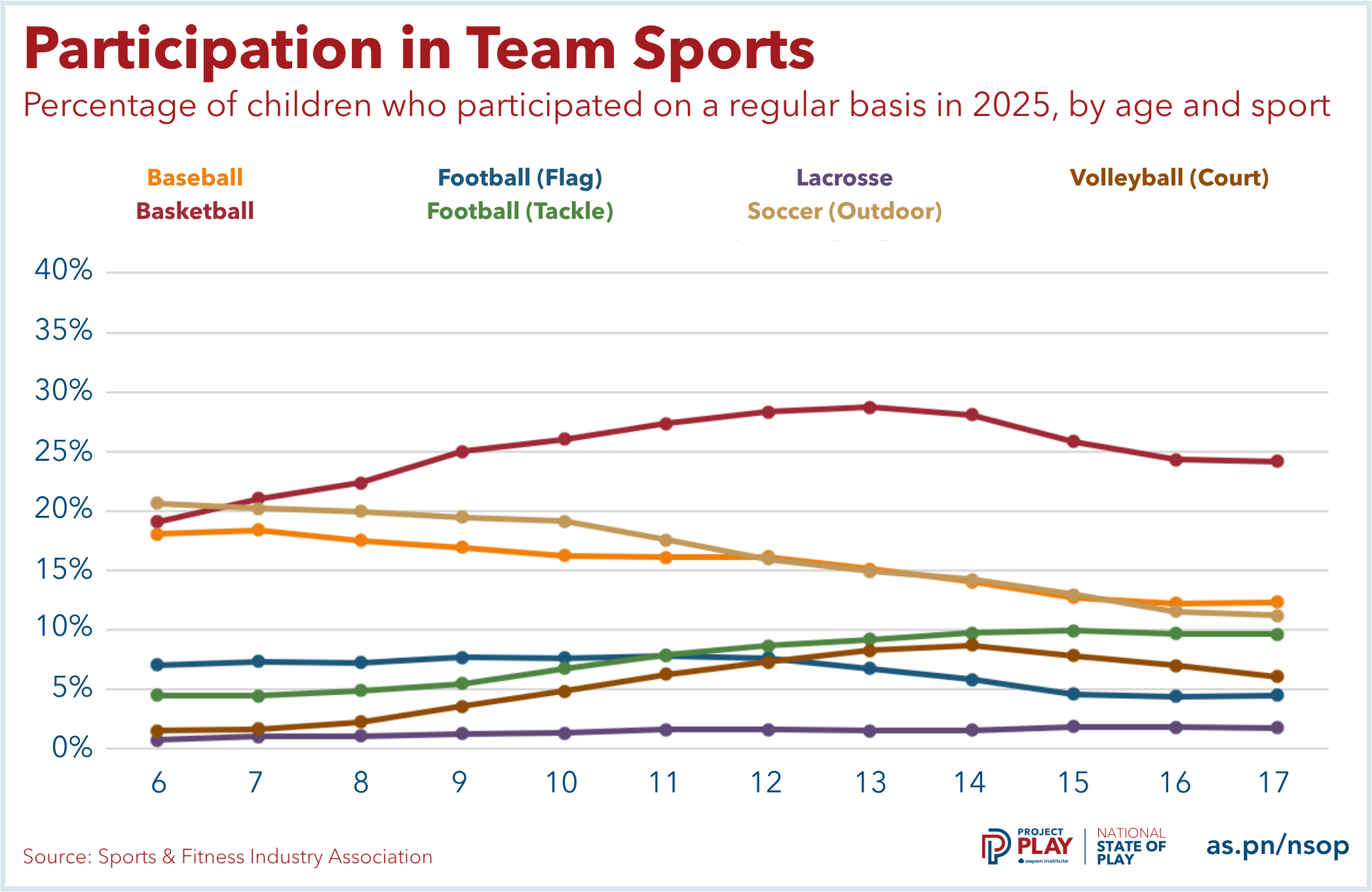
Soccer draws more 6-year-olds than any other sport at 21% participation, but participation peaks at that age and the sport immediately and continuously starts losing kids every year. Baseball follows a similar downward trajectory, falling from 18% at age 6 to 12% at age 17. Early sport specialization in both sports remains a key driver of burnout and overuse injuries.
In all sports, ages 11 to 14 represent a critical transition window, marked by movement into contact sports like tackle football and increased adoption of middle-school team sports like basketball and volleyball. Starting at 19% among 6-year-olds, basketball participation climbs to nearly 29% by age 13, remaining the single most played youth sport through age 17 (24%).
Flag football holds an early participation lead over tackle football until ages 10 to 11, when tackle overtakes flag. Tackle peaks at nearly 10% participation at age 15, while flag drops below 5%. Volleyball demonstrates the sharpest relative growth between ages 8 and 14, whereas lacrosse maintains flat participation levels across all youth age brackets.
4. SFIA data suggests continued progress against 63X30 goal
In 2021, coming out of COVID, only 49% of youth ages 6-17 played organized sports, according to federal government data. The Aspen Institute’s 63X30 national roundtable of leading organizations in sports has embraced a goal of helping the country get 63% playing by 2030 — the nation’s public health goal as codified in Healthy People 2020. Progress has been made since then, with the 58% figure from 2024 as reflected in the NCHS, the instrument Aspen uses to track gains.
The SFIA data suggests that the next round of federal government data, due in spring 2027, could show a continued lift toward that goal. Potential reasons for that growth include increased post-pandemic interest by Americans to be physically active and socialize within communities. Also, investments have been made by organizations across the landscape of youth sports, including members of the 63X30 roundtable which engaged more than 3.5 million parents and invested at least $71 million in youth sport access, safety and infrastructure. Members also trained more than 263,000 coaches and administrators in 2025.
“Participation is an important signal, but continued growth means creating the right conditions to keep kids in the game,” said Ashleigh Huffman, senior director at the Aspen Institute Sports & Society Program. “Our goal is to make sport accessible, welcoming and rewarding enough that children want to keep playing. The 63X30 roundtable’s work with parents, coaches and communities is part of building that kind of experience.”
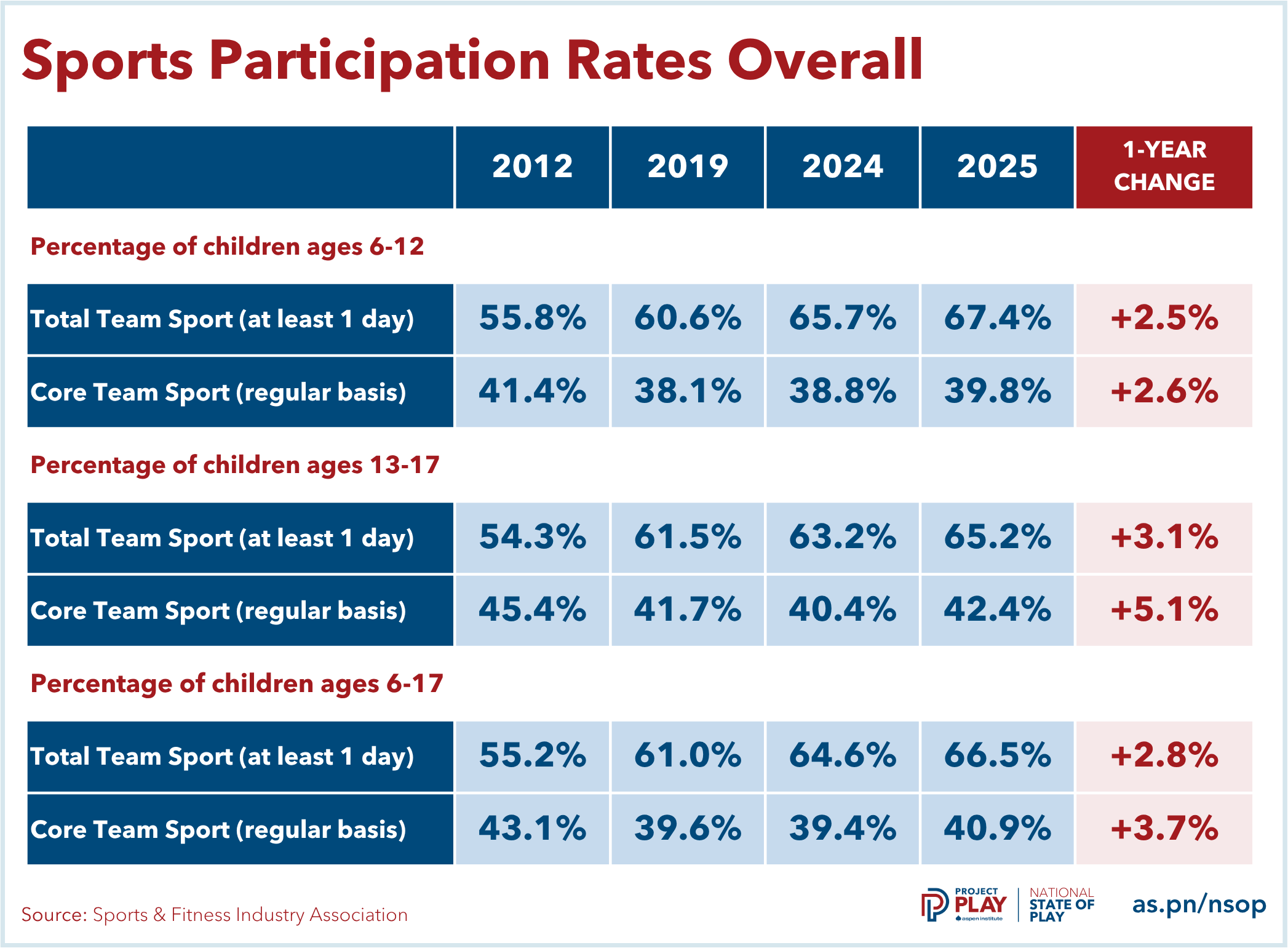
By SFIA’s measure, youth sports participation in 2025 reached its highest level in 12 years. Core team sports participation (meaning playing on a regular basis) among youth ages 6-17 reached nearly 41% in 2025, up 4% from the prior year. Nearly every demographic of child — across age, gender and race/ethnicity — experienced higher participation rates.
“Spending on fitness and sports remains resilient despite economic pressures,” said Kerman of SFIA. “Since the pandemic, families have prioritized physical activity as an essential priority. There’s just a different mindset than there used to be as families invest more of their time, energy and resources into physical activity, and that’s carried through in our numbers, which is great to see.”
5. Low-income kids are being left behind as costs rise
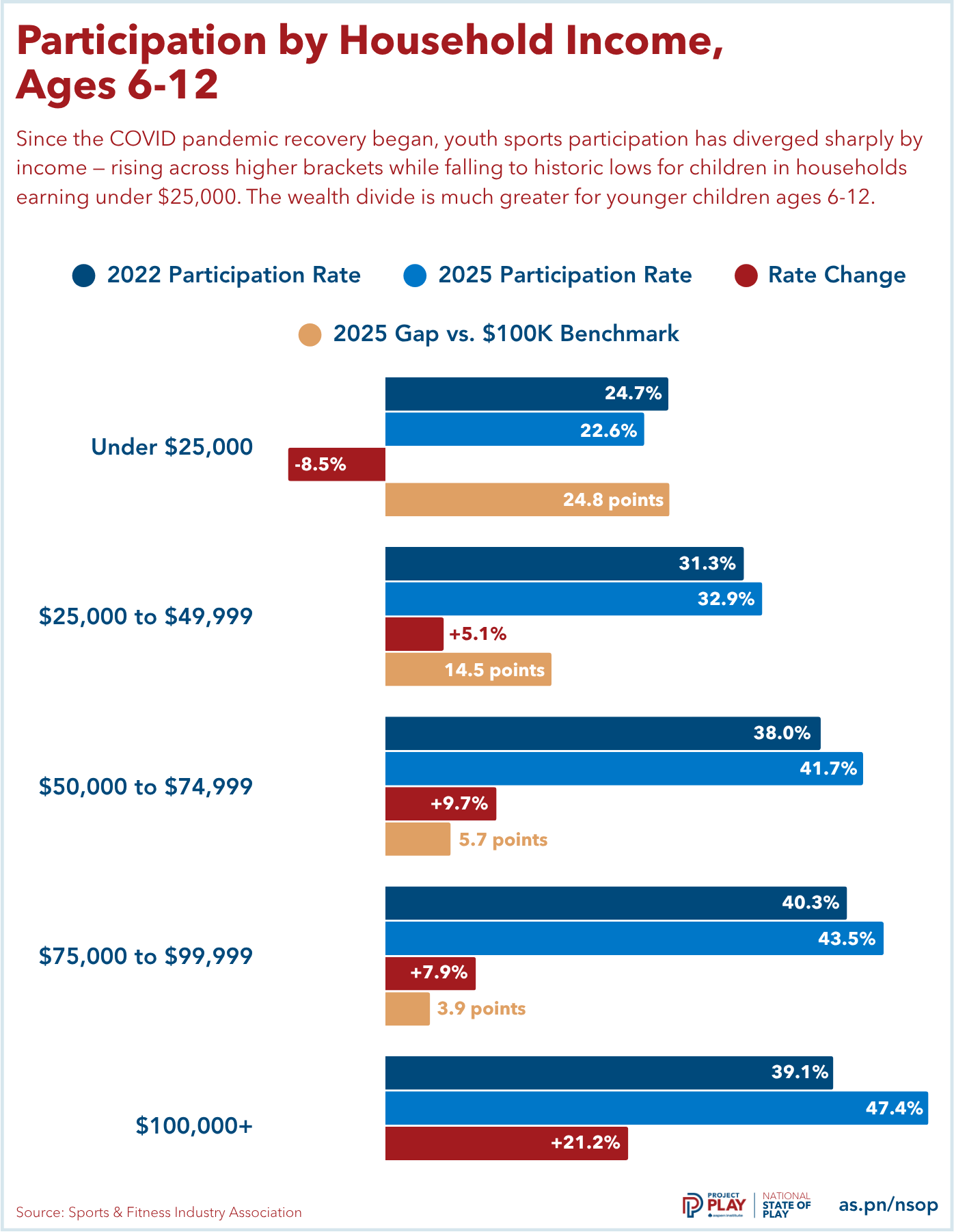
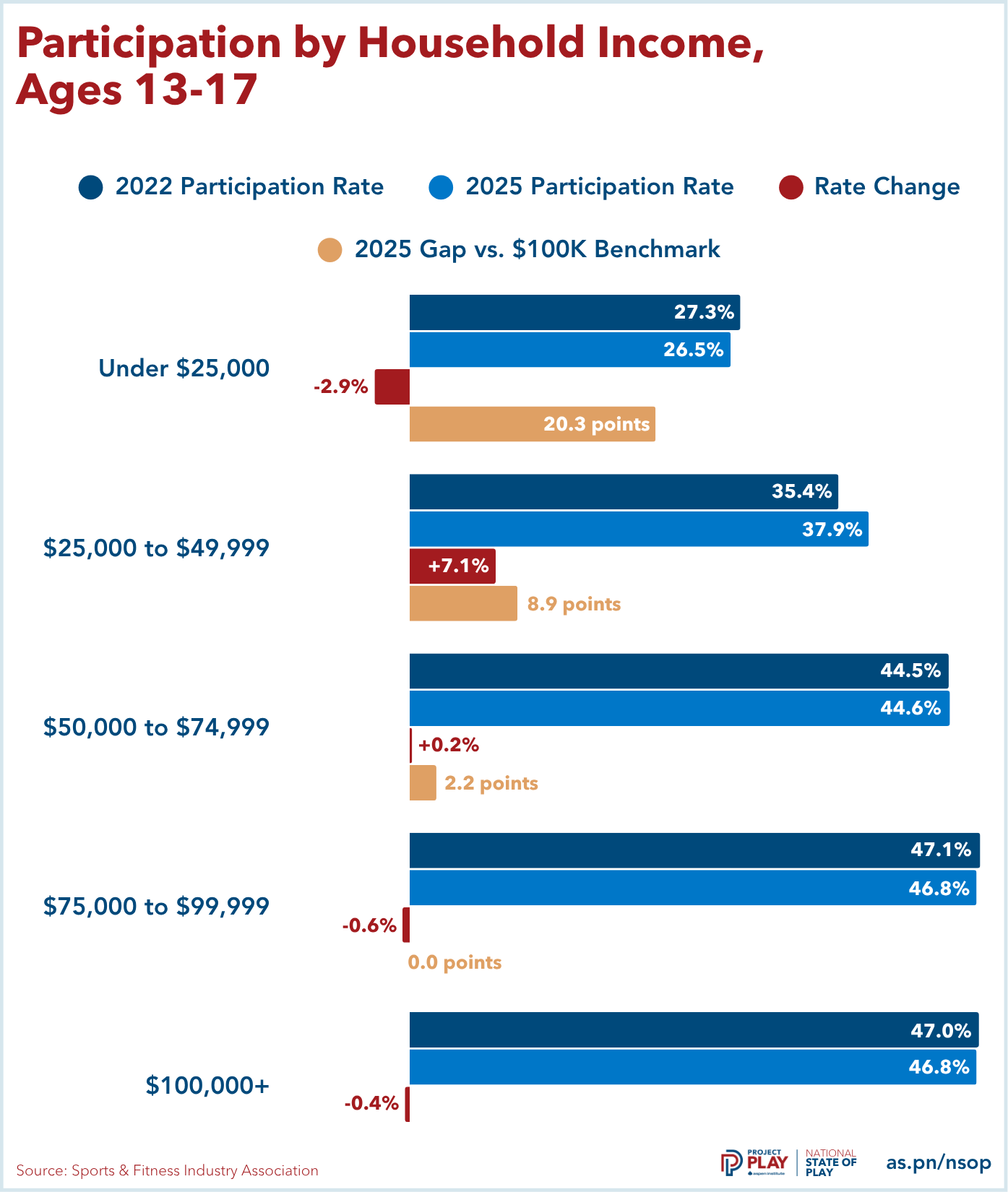
During 2025, there was a 7% single-year sports participation drop drop among children ages 6-12 living in households earning $25,000 or less. In contrast, participation across every higher income bracket grew between 2% and 7% over the same period. Coupled with rising costs to play sports entering 2026, the youth sports system may be reaching an affordability tipping point for millions of families.
Household income remains one of the strongest predictors of youth athletic participation — and that divide widened sharply in 2025. While regular participation for kids ages 6-12 in households earning $100,000 or more grew by 7% over one year, participation for youth in households earning $25,000 or less dropped by 7%. In 2022, the participation gap between the highest- and lowest-income tiers stood at 14.4 percentage points. By 2025, that gap expanded to 24.8 percentage points. U.S. Census Bureau data estimates that 11% of children ages 6-17 (5.4 million) live in households earning $25,000 or less.
“A 7% single-year drop is stunning and bad,” said Linda Flanagan, author of the book “Take Back the Game” that documents challenges in youth sports. “Is it a warning sign? It should be for public health officials, as this low-income, low-activity demographic desperately needs sports and exercise. State and local officials are going to have to start funding sports options for kids in these communities as the private options are increasingly out of sight.”
Kerman noted that manufacturers absorbed supply chain cost spikes as long as possible before raising equipment prices across the board. Combined with general inflation, lower-income family budgets were squeezed in 2025, leaving minimal margin for registration fees, equipment and travel expenses.
“We are extremely worried that all the progress we’ve made over the last several years is going to reverse,” Kerman said.
The latest SFIA data validates what Jason Clement sees firsthand managing sports facilities across the country: demand for sports is growing across all demographics, but participation among the lowest-income households is the notable exception. “This is not because these families value sports any less,” said Clement, founder and CEO of The Sports Facilities Companies. “Rather, rising costs can make participation inaccessible, and many young people must spend their time helping support their households.”
Travel expenses for youth sports are among the largest costs for families. While overall group travel as an industry stagnated in 2025 — with room bookings down 1.6% — growth in youth sports travel accelerated, according to a report by the U.S. Travel Association. The report noted that youth sports has surpassed business meetings, conventions and trade shows to become the top-producing group travel segment in some cities.
SFIA data shows that declining sports participation among low-income families hits younger children (ages 6-12) harder than teenagers (ages 13-17). SFIA Senior Director Jenny Karn attributes this to teens already locked into athletic programs, making parents more willing to absorb the cost. For younger kids, opting out before starting is far easier, keeping the habit from ever taking root.
Even if costs and inconveniences are high, many parents will make sacrifices for their child to play sports if they see a net benefit, especially after shutdowns during the pandemic. That may be lifting up the participation numbers among all youth. “When kids are playing sports, they can’t be on their phones, and parents are desperate to get their kids off screens,” Flanagan said.
But Flanagan cautions that just because participation rates are increasing for most demographics does not mean many parents are thrilled with how sports are delivered. “Parents won’t accept these (cost) increases forever,” she predicted. “And as the national spotlight starts to turn on youth sports expenses, as we’ve seen in two congressional hearings on private equity in youth sports, the parents paying the bills may start to push back.”
6. Girls play more often, and boys’ participation starts to recover
Girls’ core participation rose from 33% in 2019 to 38% in 2025 — the highest level since at least 2012. The lift, the fourth straight year of rising participation rates, comes in the wake of a push by many national and grassroots organizations to make sport more welcoming for girls, among them the Women’s Sports Foundation, Coaching Her and many Project Play Champion organizations, as well as Nike, the U.S. Olympic & Paralympic Committee, Under Armour, the DICK’S Sporting Goods Foundation and other members of the 63X30 roundtable.
“Girls’ access grows when the system changes around them,” said Huffman, who manages the 63X30 roundtable for the Aspen Institute. “That’s 63X30 in action: turning a shared goal into practical support that helps girls get on the field, feel they belong and keep playing.”
For the first time, the gender gap pulled within five percentage points of that of boys. That’s in part because boys’ participation stagnated over the past decade, a development that the Aspen Institute and the American Institute for Boys and Men (AIBM) addressed in a white paper released earlier this month, with recommendations on how to get and keep more of them playing.
The latest SFIA report offered signs of hope for boys. While the gain was smaller than that of girls, boys’ participation reached 43%, up from about 40% where it largely has been stuck since 2016. The current level remains well below that of 2013 when half of all boys played team sports on a regular basis.
“These numbers fluctuate from year to year, and it’s encouraging to see a possible uptick in boys’ participation after stagnation,” said Alanna Williams, vice president at AIBM. “But we heard in our research with boys that there’s still a lot of unmet demand for play: many boys wanted to try something new or get back into a sport but didn’t feel they had enough low-pressure options. I hope these numbers reflect both continued demand and more ways to play.”
And yet a gap remains between boys and girls — but it’s not due to demand. Girls who have never played sports are just as interested in playing as boys (54% vs. 52%), according to the Women’s Sports Foundation Sport Report 2026. Interest is even higher among Hispanic girls (61%) and Black girls (58%) who have never played.

7. Asian youth participation rates skyrocket — unlike Black youth
Over a five-year period, core participation increased across all racial and ethnic groups, led by Asian (+25%), White (+6%) and Hispanic youth (+5%), according to SFIA data. The growth of sports participation by Asian youth may be tied to household income.
Annual Census Bureau reports consistently show that Asian American households have the highest median income among all racial and ethnic groups in the U.S. Asian Americans are considerably more likely than Americans overall to live in upper-income households, according to Pew Research Center. Demographics with higher average household wealth are statistically more capable of absorbing rising youth sports expenses, even amid economic downturns or cuts to public sports programming.
The only racial demographic to not see a major sports participation lift are Black youth. Participation is up just 1% in the past five years — and it’s dropped 10% over the past decade. This makes Black youth the only racial demographic to experience a 10-year decline. From 2020 to 2024, Black households had a median income of $55,000 compared to $117,000 for Asian households, according to the U.S. Census Bureau.
“The decline in Black youth sports participation is not a failure of interest or ambition,” said Robert Marcus, chief strategy and impact officer at Positive Coaching Alliance. “It is a failure of access and investment. We've allowed rising costs, unequal resources and a lack of affordable opportunities to shut too many Black children out of sports. Reversing this trend requires more than creating programs. It demands changing the systems that have allowed these inequities to persist.”
Chris Pulley, former Fairfax County (Virginia) community outreach specialist for athletics, said sports providers that fold too often are those serving predominantly Black communities. “If those kids are in single-family households and have transportation issues, well, what do you do to play sports?” said Pulley, who now oversees Fairfax County’s coordination of veterans.
Pulley said less sports participation by Black children may also be due to bad messaging by coaches, parents or peers. One example: if a child is not the best athlete, he or she often hear that they shouldn’t play sports.
“For a lot of these kids, it’s easier to resist authority and walk away when told something like that,” Pulley said. “In my empirical observations, I’ve seen it a bunch, and the bad messaging steers kids away from group involvement in things like sports because it didn’t work for them. Unfortunately, it’s a cycle in the African-American community.”

8. Fewer adults are coaching
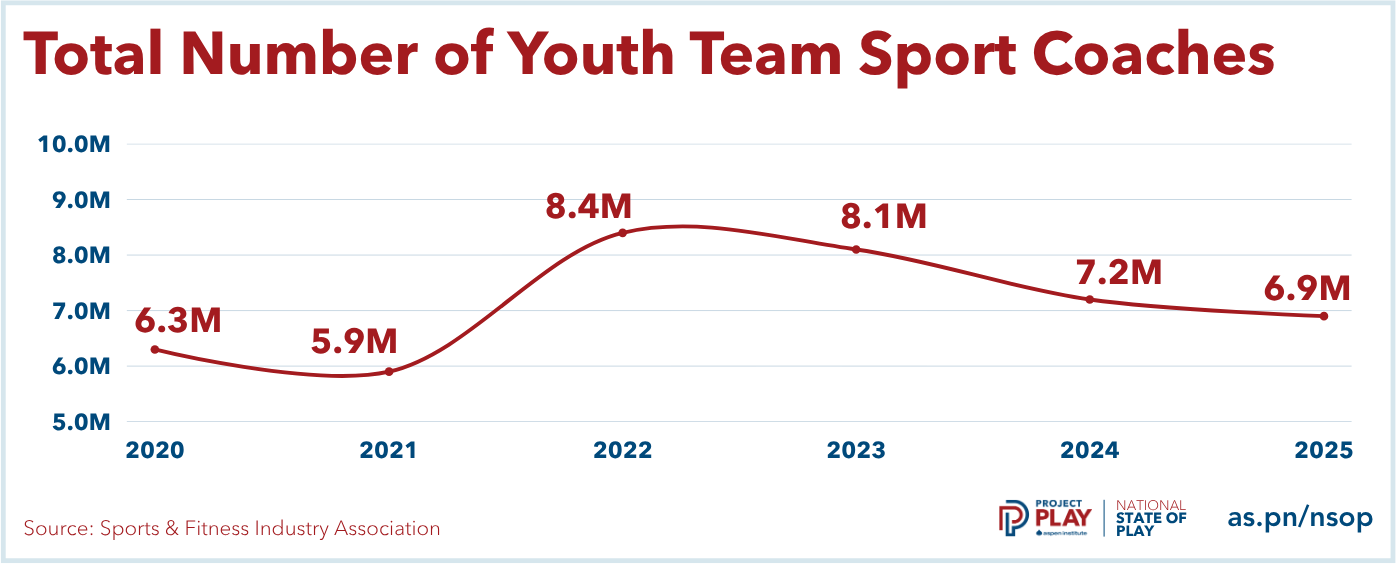
Active youth sports coaches of children ages 14 and under fell from 8.4 million in 2022 to 6.9 million in 2025, marking three consecutive years of decline. (The data doesn’t include coaches of high school-age athletes.) At the same time, the number of self-identified former coaches rose for the fourth straight year, climbing from 9.8 million in 2021 to 12.3 million in 2025.
This surge in former coaches highlights a clear retention problem.
“Recruiting and retaining coaches is a consistent challenge for youth sports providers," said Brian McFadden, youth sports program manager with the National Recreation and Park Association, a member of the 63X30 roundtable. “Time constraints, lack of confidence, insufficient training and unchecked parental behavior all put a strain on the youth sports coaching ranks. Providers who ensure quality training, clear expectations and gracious recognition are the ones most likely to find success attracting and keeping coaches in the game."
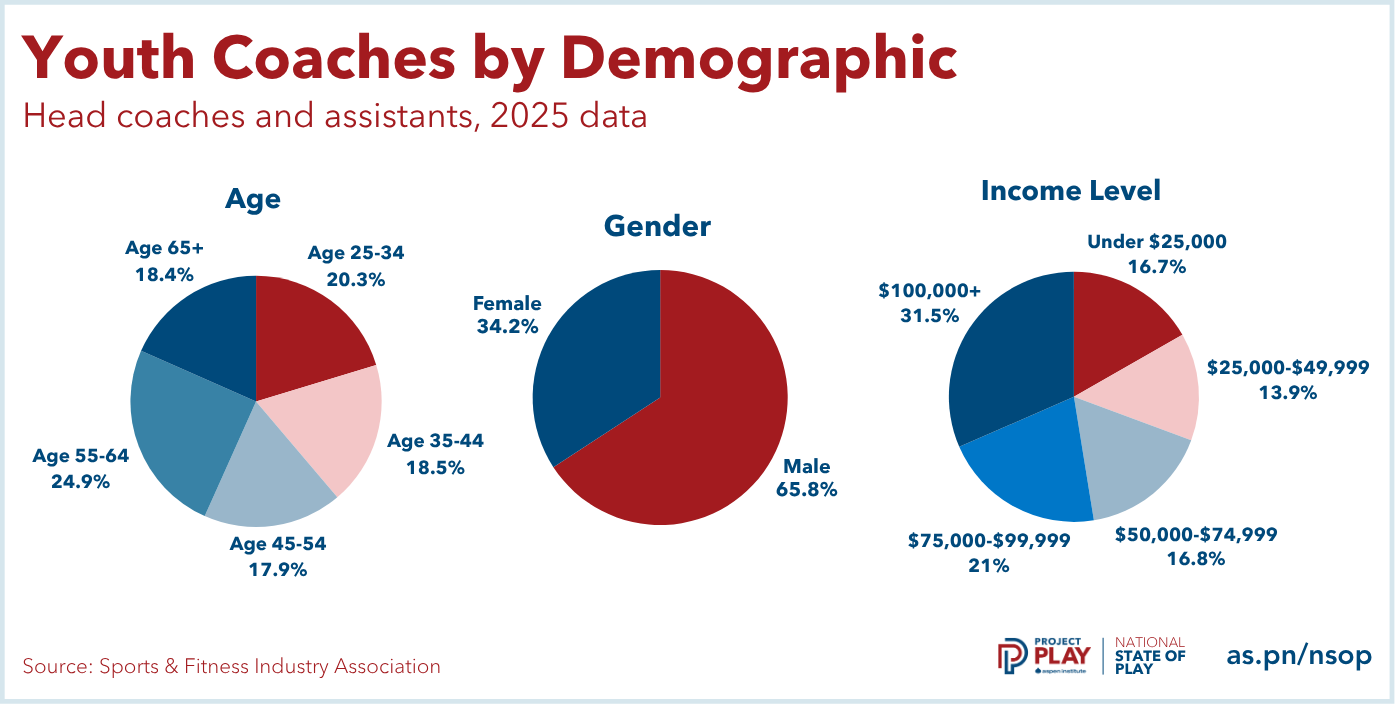
Additionally, coaches ages 55 and older now comprise 43% of the coaching field for youth 14 and under, driven largely by retiring baby boomers stepping into volunteer roles.
“We need to make sure that lack of coaches is not the bottleneck that keeps kids from being able to play,” said Karn of SFIA. “We need to do more to get people interested in being coaches, and then also retain them once they’re there.”
Meanwhile, the percentage of head coaches or assistant coaches of 14-and-under teams who are women reached 34% in 2025, the highest on record tracked by SFIA since at least 2013. As recently as 2019, only 26% of surveyed head and assistant coaches were female.
In recent years, many organizations have created initiatives and resources to grow the number of female coaches. One example: 35% of the U.S. Tennis Association’s 20,000 coaches are women through efforts to help them learn different coaching pathways as teenagers, college athletes and professional women.
“Women need to know coaching is an option for them and it can be a whole career path where you make money,” said Megan Rose, who recently departed as managing director of USTA Coaching.
9. Training for coaches has decreased
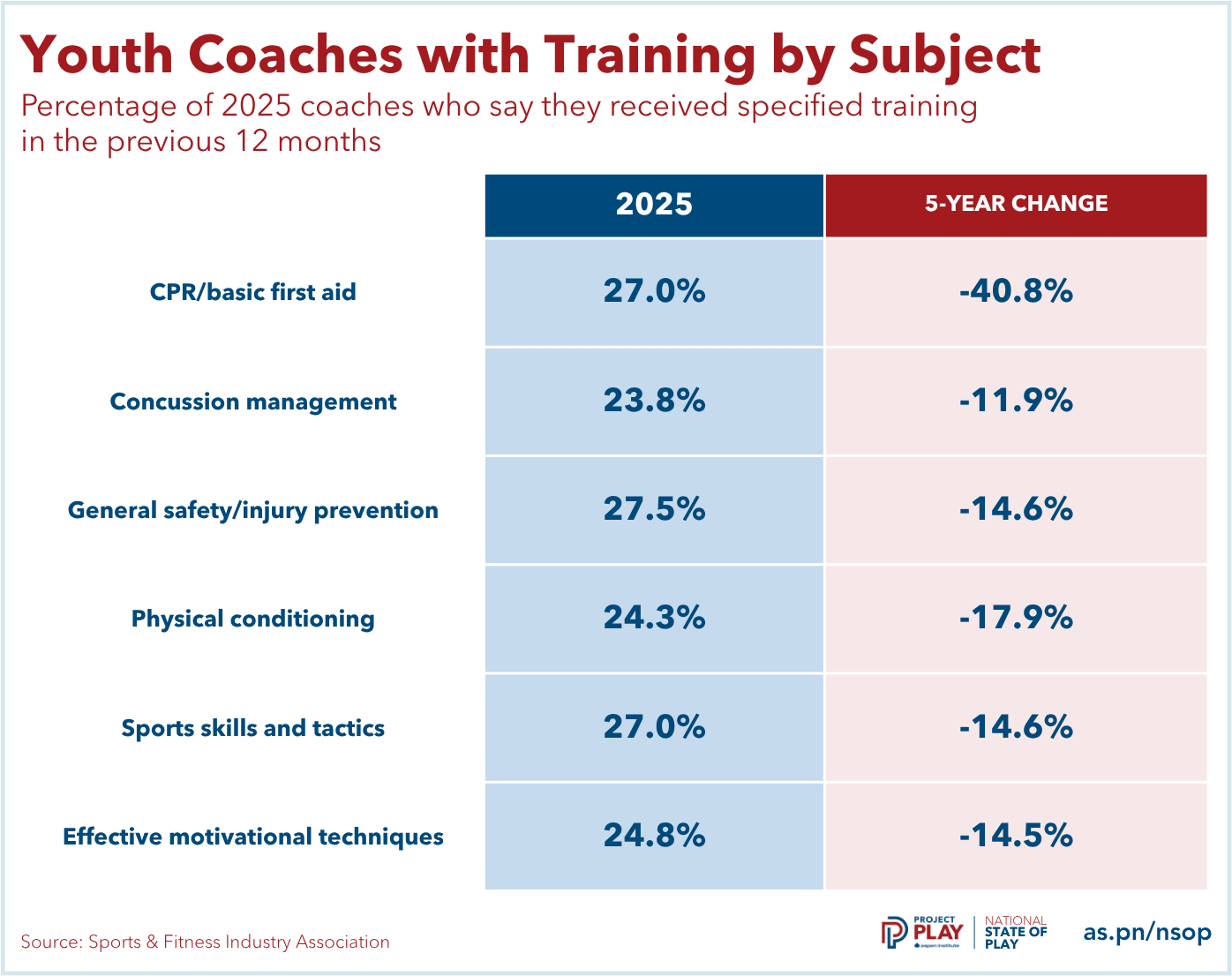
While 94% of active youth coaches in 2025 reported receiving training at some point in their lives, annual ongoing training has fallen significantly.
Coaches completing training within the previous 12 months declined across every category measured by SFIA between 2020 and 2025. Annual training in CPR/basic first aid, concussion management, general safety/injury prevention, physical conditioning, sport-specific skills and motivational techniques all suffered double-digit percentage drops over the five-year period.
What’s causing the decline in training? The SFIA data in and of itself doesn’t explore those answers. Dr. Vincent Minjares, Aspen Institute Sports & Program manager, identified some possible explanations:
An older coaching workforce that has already completed CPR or concussion training.
Uneven training incentives, requirements and enforcement, due in part to concerns about costs, administrative hurdles and impact on volunteerism.
Low rates of training for injury prevention, physical conditioning, sports skills/tactics and motivation suggest that many coaches feel they already have this knowledge.
Bias of coaches toward self-directed learning (such as YouTube and clinics) and away from formal training and education.
Coaching in completely unregulated environments (such as private trainers and independent clubs) and parents don’t think to ask about their training.
“As our collective attention to coaching grows, this data only reinforces the larger challenges before the youth sports sector,” Minjares said. “Too many coaches still have not completed the foundational training needed to keep kids safe and coach them well. As a field, we must develop solutions to overcome barriers to training, including helping local providers implement incentives and enforce requirements, designing great training that coaches value, and engaging independent coaches that operate outside of regulated environments. It can and must be done.”
The Sports & Fitness Industry Association (SFIA) commissioned an online, nationally representative survey from Sports Marketing Surveys (SMS), which the Aspen Institute uses annually to track participation and coaching data. In 2025, the most recent year with available data, SMS conducted 18,000 online interviews among a national sample representative of the U.S. population ages 6 and older. Quotas were applied for gender, age, income, geographic region and ethnicity. Activity reporting is based on a rolling 12-month participation rate.
Jon Solomon is Research Director for the Aspen Institute Sports & Society Program. Email him at jon.solomon@aspeninstitute.org.