
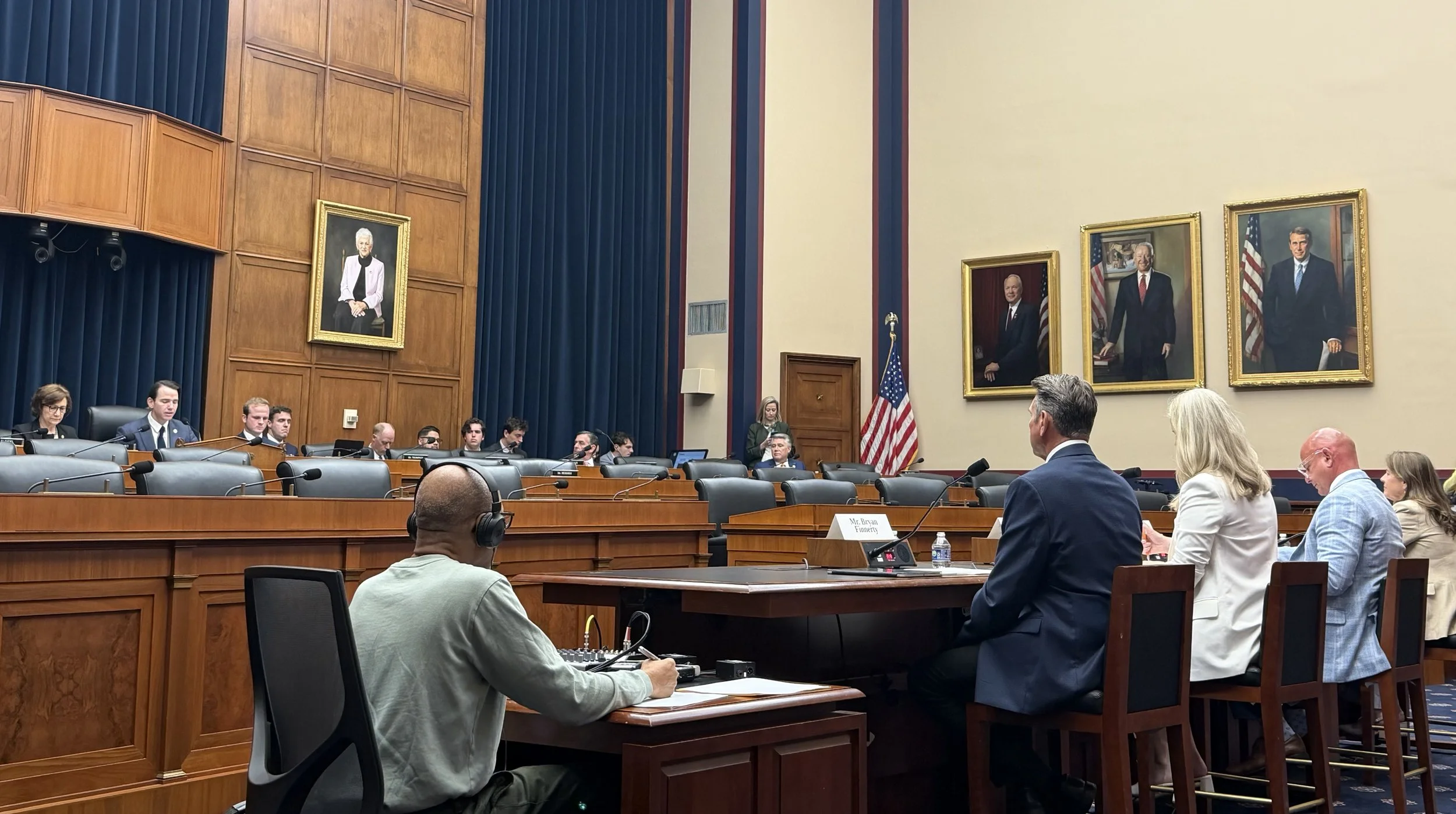
On Tuesday, the Subcommittee on Early Childhood, Elementary, and Secondary Education held its second hearing on youth sports, “Field of Fees,” focusing on the rising cost of youth sports participation, especially where private equity has invested in facilities and programs. This hearing was a follow-up to December’s hearing where Tom Farrey testified. Here are five thoughts on the hearing and where the policy conversation goes next:
There is very little distance between Republican and Democrats on this issue
Members on both side of the room noted in their questioning that championing youth sports access is a bipartisan priority. Rep. Suzanne Bonamici (D-OR), the session’s ranking Democrat, began her questions by noting “I’m encouraged that there’s a vast amount of agreement on both sides of the aisle with we’re talking about today.” Rather than limiting questions to witnesses invited by their own party or asking “gotcha” questions of the other party’s witnesses, members from both sides of the aisle seemed to share a genuine conviction that an access divide in youth sports is a serious social issue.
Perhaps the only partisan division of note was around H.R.8788, the Let Kids Play Act, a measure introduced by Democrats last month that would ban “vulture investors” using business practices the Democrats argue are responsible for driving up costs from operating youth sports businesses. To date, the bill has 10 Democratic co-sponsors but no Republican support. Two of those co-sponsors, Summer Lee of Pennsylvania and John Mannion of New York, participated in the hearing. Lee indicated that youth sports is the first step in a larger Democratic plan to regulate private equity, with other industries like nursing homes and hospitals likely to also fall under scrutiny. “If private equity monopolizing youth sports is what it takes to get Republicans on board with enforcing antitrust laws, then I welcome that,” said Lee. “I will happily work with you to get private equity out of youth sports, but I would love if we could apply this same level of urgency to protecting all children, families and workers.”
Most Republicans did not tip their hand one way or the other on the Let Kids Play Act. Michael Rulli of Ohio did speak in defense of Black Bear Sports, the ice rink owner-operator that has been at the center of much of the media coverage of the issue and which invested in a rink in Rulli’s district. “Black Bear Sports Group supported upgrades to the facility roughly exceeding $1.2M and continues supporting the Youngstown Phantoms, which is the minor league hockey team of Youngstown, and also the youth sports groups with the ‘Give Hockey a Shot’ program,” he argued. Rulli did not direct any questions to witness Matt Kakabeeke, whose Kalamazoo Optimist Hockey Association was evicted from a Black Bear-owned rink earlier this year.
Youth sports has a jurisdiction problem
This hearing, like the hearing Tom Farrey and Katherine Van Dyck spoke at in December, was organized by a subcommittee of the House Committee on Education and the Workforce. This isn’t the committee with primary jurisdiction over the Let Kids Play Act – that’s the Judiciary committee. It’s also not the committee with jurisdiction over the Youth Sports Facilities Act (that was referred to Transportation and Infrastructure), nor is it the committee with jurisdiction over the PLAY Act (which went to Ways and Means), nor is it the committee that heard the recommendations of the Congressional Commission on the State of U.S. Olympics & Paralympics (that was Energy and Commerce).
This varied jurisdiction, and the quick two-year turnover of a very busy House, means that most members are coming to this issue with much interest but little expertise. Many of the members quoted back to the witnesses the same statistics the witnesses included in their written testimony. Without a single bill, single committee or single champion for youth sports, conversations on this topic rarely move beyond the surface level.
Youth sports has a college sports problem
To the extent that Congress is paying attention to amateur sports, most of that attention is directed toward college sports. After the House was unable to find a deal to move the SCORE Act forward, attention has shifted to the Senate’s bipartisan Protect College Sports Act. The witnesses argued that the college sports system and the youth sports system are two sides of the same coin. As college sports has commercialized and it has become easier for athletes to be compensated through name, image and likeness (NIL) and direct payments, the pressure felt by youth sports families has ramped up. In response to a question from former NFL player Burgess Owens (R-UT) on NIL payments to high schoolers, Take Back the Game author Linda Flanagan noted, “When I wrote my book, parents felt compelled to launch into this because they hoped for a college scholarship or access to a better college, but now with the specter of NIL, we’re seeing the commercialization effect in youth sports so that what you gained when you played – the teamwork, the leadership skills, those kinds of values are being crowded out by market values.”
From P.E. back to P.E.?
The witnesses called for direct funding of youth sports programming out of the federal budget. Flanagan compared the competition-driven American system to the participation-driven Norwegian system, which is subsidized by revenues from the national lottery and has over 90% participation. Van Dyck reminded the committee that the congressionally-chartered U.S. Olympic & Paralympic Committee, despite being officially tasked with growing amateur sport, receives no federal funding to support that mandate. Van Dyck also noted that while parent spending on corporate youth sports is inherently extractive, as some of that money leaves the community through profits and dividends, government spending on community youth sports would be more likely to be reinvested.
Members seemed interested in the idea. The hearing’s chair, Kevin Kiley (I-CA), concluded the hearing with a call for investment at all levels of government in facilities and infrastructure. Ranking member Bonamici agreed, calling for investment in schools, parks and recreation. Of course, it’s easier to say government should spend than it is for government to spend, but at least one representative was doing the back-of-the-envelope math – Bobby Scott (D-VA) noted the estimated $40B parents spend on youth sports annually and compared that to the $7T federal budget. “There are about 50 million students, at $2000 apiece, that would be $100B… It seems like we have the money if we would just make the effort.”
Reversing the commercialization effect
The clearest message from the witnesses was that private investment in youth sports is not inherently negative. The negative effects come when profit motive override the best interests of kids. Witnesses and members spoke positively of public-private partnerships where private investment has supplemented limited community budgets, but where the community partner has retained the power to set guardrails. Witness Bryan Finnerty, who owns a private facility in southeast Michigan, noted, “When those things are done in tandem, you do have a requirement – speaking from the private side – that when on public land or working in combination with a public entity, you have a check-balance that obviously you’re serving that community… I don’t think those things are in conflict with each other.”
Where does the issue go from here? The House is in the middle of primary election season and stands on the cusp of a contentious general campaign, so it feels likely that this hearing is the last official word on the subject for this Congress (apart from whatever new measures that may be introduced to support campaign platforms). More and more members are coming around to the idea that youth sports could benefit from some oversight, so perhaps Congress will ride the momentum from successfully passing college sports legislation into addressing youth sports, but realistically, it will take more work from youth sports organizations (or a youth sports media crisis) to educate policymakers before we’re likely to see real action.
Marty Fox is program manager for the Aspen Institute’s Sports & Society Program, advancing the 63X30 roundtable, the Children’s Bill of Rights in Sports, and other priority projects.