
Photo: Getty Images
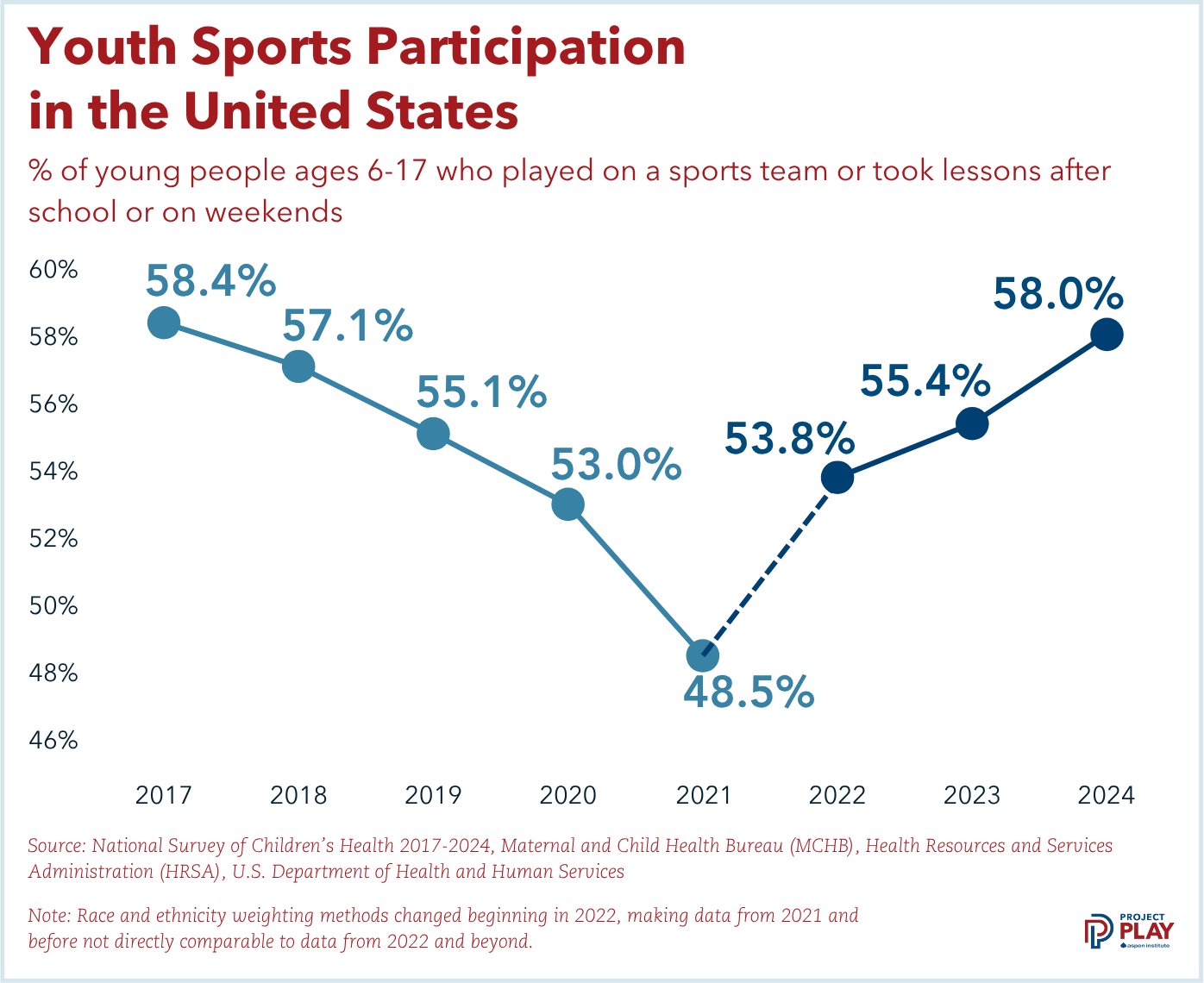
U.S. youth sports participation tracked by the federal government rose to 58% in 2024, marking a significant one-year increase and nearly returning to its level almost a decade ago. Organized sports participation grew among boys, girls and all racial and ethnic groups, but the gap continued to widen based on household income.
The latest data, which generally has a two-year lag time before release, came from a question asked annually to parents of children ages 6-17 in the National Survey of Children’s Health: “During the past 12 months, did this child participate in a sports team or did they take sports lessons after school or on weekends?”
Since 2019, the federal government’s Healthy People 2030 program has set a goal for 63% of children to participate in organized sports by 2030. The Aspen Institute’s Project Play initiative, embracing that goal as its own, convenes a national roundtable of 20 organizations called 63x30 that have made multiyear commitments to take mutually reinforcing actions to help increase sports participation.
In 2024, sports participation was nearly back to the 2016-17 level of 58.2% that serves as the baseline for the 63% goal. Healthy People 2030 tracks the data over two-year periods while Project Play reports on the data annually for more real-time observations. Combined 2023-24 data is not yet available.
Other trends from the 2024 data:
State progress toward federal goals
15 states successfully met the 63% participation goal for all youth in 2024: New Hampshire, Nebraska, North Dakota, Massachusetts, Vermont, Washington D.C., Connecticut, Minnesota, Kansas, Illinois, Colorado, Hawaii, Maryland, Iowa and Missouri. That was the same number of states that reached 63% in 2023.
New Hampshire (74.3%) had the highest 2024 participation rate. Delaware (48.6%) was the lowest. State-by-state results are available here.
Gender gaps and state-level disparities
The national participation gap between boys (61.1%) and girls (54.9%) shrunk, dropping from 10 percentage points in 2023 down to 6.2 percentage points in 2024.
Despite this progress, only 7 states met the 63% goal for girls: New Hampshire, Massachusetts, Iowa, Kansas, Vermont, Hawaii and Indiana. Twenty-four states had at least 63% of boys participating in sports.
Only four states had a higher percentage of girls playing sports than boys: Massachusetts, Iowa, Indiana and Michigan.
Deepening socioeconomic divides
Children in the lowest-income households (0-99% of the poverty level) were the only economic category to decrease their sports participation in 2024. Only 36.3% of these children played sports; back in 2016-17, 40.8% participated.
The gap between the poorest and wealthiest children continues to widen, reaching 38.5 percentage points in 2024 (up from 36.7 in 2023 and 34.9 in 2016-17).
A similar divide exists based on household education. The gap between children in households with a college degree versus those with less than a high school education grew to 41.8 percentage points in 2024.
Language and demographic improvements
Participation increased across all genders and racial/ethnic groups between 2023 and 2024. The participation rates in 2024 still show significant gaps: White 65.5%, Asian 56.8%, Black 49.6% and Hispanic 48.6%.
The participation gap between English and non-English speaking households decreased by 20% between 2022 and 2024, dropping to a 19.8 percentage point difference.
Hispanic children in primarily non-English speaking homes (38.7%) saw their sports participation increase for the third consecutive year, though they still lag behind Hispanic children in English-speaking homes (57.1%) and non-Hispanic children (61.6%).
Family structure and child well-being
Children living with two currently married parents played sports at significantly higher rates (64.7%) than those living with single parents (45.3%) or unmarried parents (49.8%).
Children with disabilities increased their sports participation from 46.9% to 49.7% in 2024. That remained considerably lower than children without disabilities (61.1%).
There is a clear association between sports participation and a "child flourishing" (defined as showing interest in learning new things, finishing tasks they start, and staying calm when faced with a challenge). Almost 63% of children who met all three flourishing items participated in sports during 2024, up from 59.4% a year earlier. Children who met zero or one flourishing criteria saw their sports participation decrease from 44.1% to 43%.
Reaching 63% participation in sports could deliver more than 1.8 million Quality Years of Life, plus a $80 billion in societal benefits from direct medical costs saved and greater worker productivity, according to a 2023 study published in the American Journal of Preventive Medicine by researchers from the Aspen Institute, U.S. Department of Health and Human Services, and leading universities.
Jon Solomon is Research Director for the Aspen Institute Sports & Society Program. Email him at jon.solomon@aspeninstitute.org.