
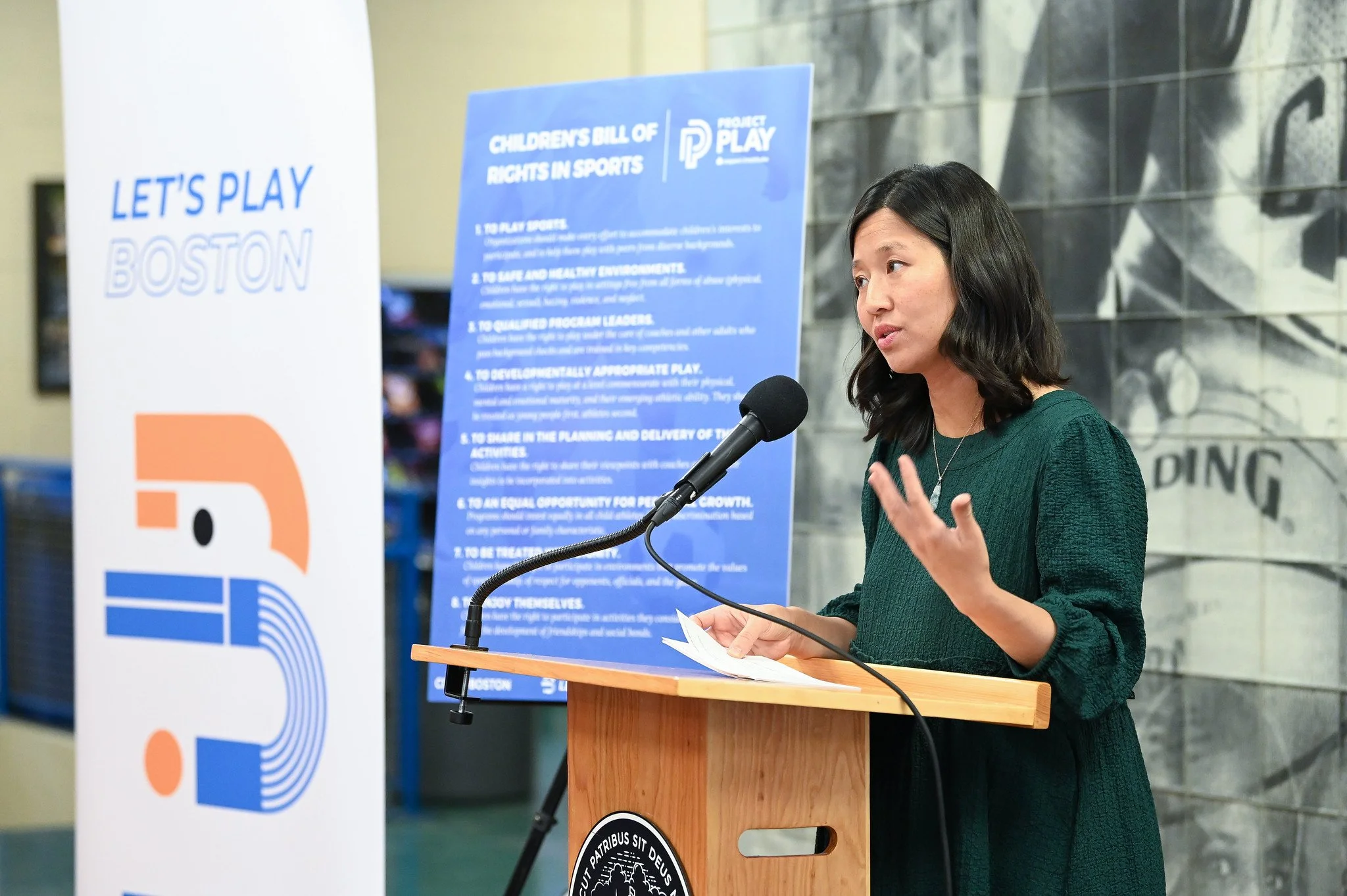
Boston Mayor Michelle Wu endorses the Children’s Bill of Rights in Sports and announces the launch of Let’s Play Boston at a press conference November 13, 2024. Mayor's Office Photo by Isabel Leon.
This guest article was written by Youth Media Forward, an initiative of the Centre for Sport & Human Rights. As part of the broader Generation 26 project, Youth Media Forward is working with young journalists and creators in four of the FIFA World Cup 2026 host cities, during the preparations for and delivery of the event.
As Boston prepares to welcome national leaders in youth sports at the Project Play Summit and take on its role as a host city for the FIFA World Cup 2026, the city is amidst deep efforts to reshape how young people access and experience sports.
In recent years, under Mayor Michelle Wu, Boston has begun to rethink youth sports as one system that, for many families, has historically been difficult to navigate or access. City officials say that the goal is not just to expand opportunities, but to make sure those opportunities actually reach the people who need them most.
“We definitely want to make sure Boston is a welcoming home for all families,” said José Massó, Chief of Human Services for the City of Boston. “From a parent’s perspective, the question was simple: if I want to sign my child up, where do I go?”
That question became the central point for Let’s Play Boston, a citywide initiative designed to make youth sports easier to find, afford, and access. One of its first steps was building a centralized online directory, which now features more than 200 programs, along with a facilities map that features a variety of sports and where they exist across the city, as well as how families can use them.
Through outreach with local organizations, officials identified a consistent set of barriers, including but not limited to: high costs for equipment and registration, limited transportation, and uneven access to facilities. For many families, especially in lower-income and POC communities, those obstacles made participation difficult even when programs were available.
In response, Boston has invested roughly $300,000 in grants to youth sports organizations, helping cover equipment, reduce fees, and expand access to spaces across the city. At the same time, the initiative has focused on strengthening the broader ecosystem, supporting coach training, building partnerships, and creating more opportunities for collaboration between schools, parks, and community groups.
“We’re not just trying to create programs. We’re trying to connect what already exists,” said Tyrik Wilson, Youth Sports Initiative Manager for the City of Boston and the manager of Let’s Play Boston. That emphasis on coordination has become the very defining element of Boston’s approach. By bringing together departments like Boston Public Schools and Parks and Recreation, the city has worked to expand access in more intentional ways. In some cases, that collaboration has led to new opportunities such as citywide leagues and tournaments, while in others, it has simply made existing programs more visible and easier to navigate.
Still, officials say access alone isn’t enough without addressing deeper inequities in who participates.
One of the clearest gaps has been in girls’ sports. According to Wilson, many girls leave sports earlier due to a lack of role models, limited programming, or competing responsibilities at home.
To address that, the city launched its “She Coaches” campaign, aimed at increasing the number of women coaches and creating more supportive pathways for girls to stay involved.
“There’s a need to create balance,” Wilson said. “A lot of girls fall out of sports early, and we’re trying to change that.”
The city has also focused on bringing sports directly to young people through expanding programming within schools and community centers so that participation doesn’t depend on transportation or scheduling flexibility.
“Regardless of the community, there are always obstacles,” Wilson said. “Our job is to make it as easy as possible for young people to take part.”
Beyond increasing participation, Boston’s approach reflects a broader understanding of what youth sports can provide. City leaders describe the initiative as an investment not only in physical health, but in life skills, education, and community connection. Programs increasingly incorporate mentorship and personal development, expanding the role of sports beyond competition.
“Sports bring people together,” Massó said. “You’re learning teamwork, discipline, and even exposure to careers. You’re getting more than just the game.”
Boston’s role as a host city for the FIFA World Cup 2026, with matches set to take place nearby in Foxborough, has also added a layer of urgency and opportunity to the city’s youth sports efforts. While city leaders expect the event to bring economic activity and global attention, they say the bigger focus is on what lasts beyond it. Plans for large public fan events and increased tourism are already underway, but officials emphasized that the goal is to shift that momentum into long-term investment in local sports access.
“What can we keep for our communities, especially for our young people?” Massó said, pointing to the city’s broader effort to ensure that global events leave behind stronger opportunities for the next generation instead of just passing by.
The city’s long-term goal aligns with a national benchmark of reaching 63 percent youth sports participation by 2030. While officials acknowledge that gaps exist, particularly across race and gender, they point to early progress in expanded opportunities, stronger partnerships, and a more connected system overall.
For both Massó and Wilson, the work is also personal. Having grown up in Boston and experienced youth sports firsthand, they see the initiative as a way to give back to their city and create for the next generation.
“Being able to give back and make things better than what we experienced—that’s the goal,” Wilson explained.
As Boston continues to expand on youth sports, the measure of success will go beyond participation numbers but reflect that, regardless of background, young people can see sports as something that belongs to them.
“Kids will have more opportunities, more access, and more pride in being from Boston,” Wilson remarked.
Enkhsaruul Sandagsuren is a rising sophomore at Harvard University, studying Government. While in high school in Los Angeles she was a student journalist with Generation 2026, Youth Media Forward.