
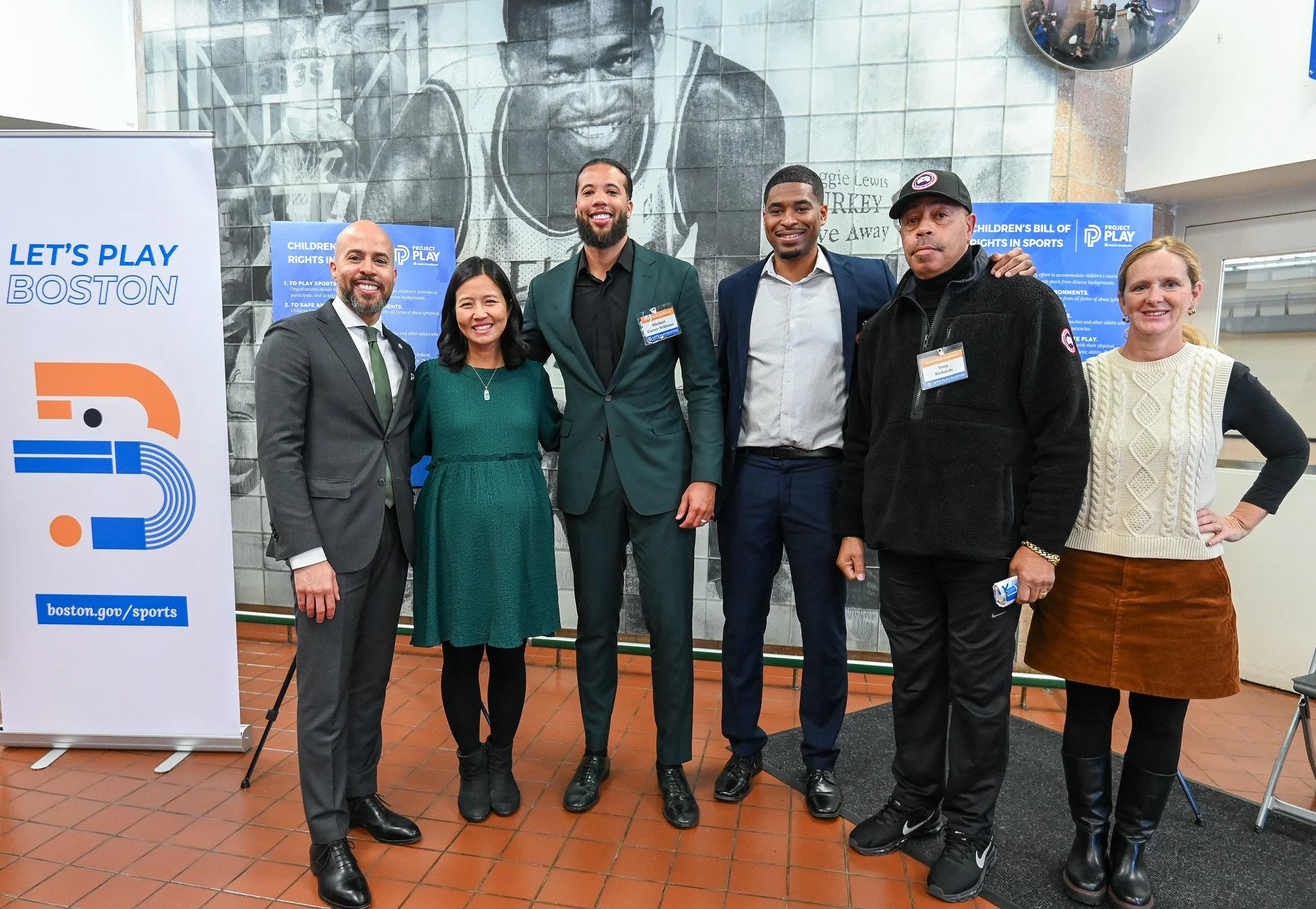
José Massó (left) and Tyrik Wilson (third from right) join civic leaders at the announcement of Let’s Play Boston, November 13, 2024. Mayor's Office Photo by Isabel Leon.
This guest article was written by Youth Media Forward, an initiative of the Centre for Sport & Human Rights. As part of the broader Generation 26 project, Youth Media Forward is working with young journalists and creators in four of the FIFA World Cup 2026 host cities, during the preparations for and delivery of the event.
In Boston, efforts to expand access to youth sports are being driven not just by policy, but by locals who grew up in the system themselves.
At the center of that work are José Massó, the city’s Chief of Human Services, and Tyrik Wilson, Youth Sports Initiative Manager and the leader of Let’s Play Boston, a citywide initiative designed to make youth sports more accessible and equitable. Together, they are helping to shape how young people across Boston experience sports with a focus on expanding opportunity.
For both Massó and Wilson, the work is deeply personal.
They grew up in Boston, where sports played a central part in their lives–not through formal systems, but through community and local programs. Those early experiences continue to shape their perspective on expanding access, equity, and the potential benefits that youth sports can offer beyond a hobby.
Wilson’s path into this line of work was shaped early on by his family. Raised by parents involved in nonprofit work, he grew up with a strong sense of community responsibility. Sports became one of the ways he could carry that forward.
“Giving back and trying to support the community has always been ingrained in me,” Wilson said.
He played a variety of sports growing up, including football and volleyball. Over time, he moved into coaching and youth work, eventually finding a role where he could help create opportunities for others and develop people’s love for sports. Wilson stressed how great it is for him to have a job that combines his passion and professional work.
Massó’s journey followed a similar path. As a young athlete, he participated in swimming, basketball, and baseball before transitioning into coaching at an early age. One of his most formative experiences came when he helped build a youth swim team at a local Boston pool.Out of 24 swimmers, he recalled, 18 had to learn how to swim or develop proper technique. By the end of the season, the team placed third in the city.
But for Massó, the most meaningful outcome wasn’t the ranking.
“It was seeing their confidence grow,” he said.
That experience of watching young people build both skills and confidence continues to shape how he approaches youth sports today. For both leaders, sports were never just about the competition — they were about growth, connection, and opportunity.
Now, in their line of work, Massó and Wilson are working to expand access to those same experiences on a city-wide level. The effort focuses on reducing barriers such as cost, transportation, and lack of awareness, which they say are the core challenges many families in the city still face.
Both emphasize that the value of youth sports extends far beyond the game itself. For them, sports are a way to build confidence, develop life skills, and create a sense of belonging.
“Sports bring people together,” Massó said. “You’re learning more than just the game.”
Wilson seconded that idea, pointing to the broader impact sports can have on how young people see themselves and their future.
“Being able to give back and make things better than what we experienced — that’s the goal,” he said.
As Boston continues to invest in youth sports, both leaders emphasized the long-term goal of helping young people feel supported, included, and connected to their communities.
Enkhsaruul Sandagsuren is a rising sophomore at Harvard University, studying Government. While in high school in Los Angeles she was a student journalist with Generation 2026, Youth Media Forward.