
Photo: Getty Images
The Aspen Institute’s Project Play initiative partnered with Utah State University and Louisiana Tech University for a first-of-its kind national youth study to understand children’s experiences in sports. Almost 4,000 youth nationally participated in the survey, which assessed sports-related perceptions of youth who currently play organized sports, formerly played or have never played. This story reports key findings from the full report.
The Aspen Institute’s No. 1 strategy to increase youth sports participation is to ask kids what they want. So that’s what we did.
Support or pressure applied by parents can make or break a child’s experience in sports. Fear of injury is a major barrier for non-athletes, older youth and girls to play sports. Public facilities and schools are vital to engaging youth who have never played sports, with schools especially helping Black youth participate.
Read the entire National Youth Athlete Survey results here.
Topics in the report explore sport participation, sport settings, sport outcomes, coach engagement, parent involvement, injury risk and video games. Results are analyzed by age, sex, race/ethnicity, affluence, U.S. region, select states and certain sports.
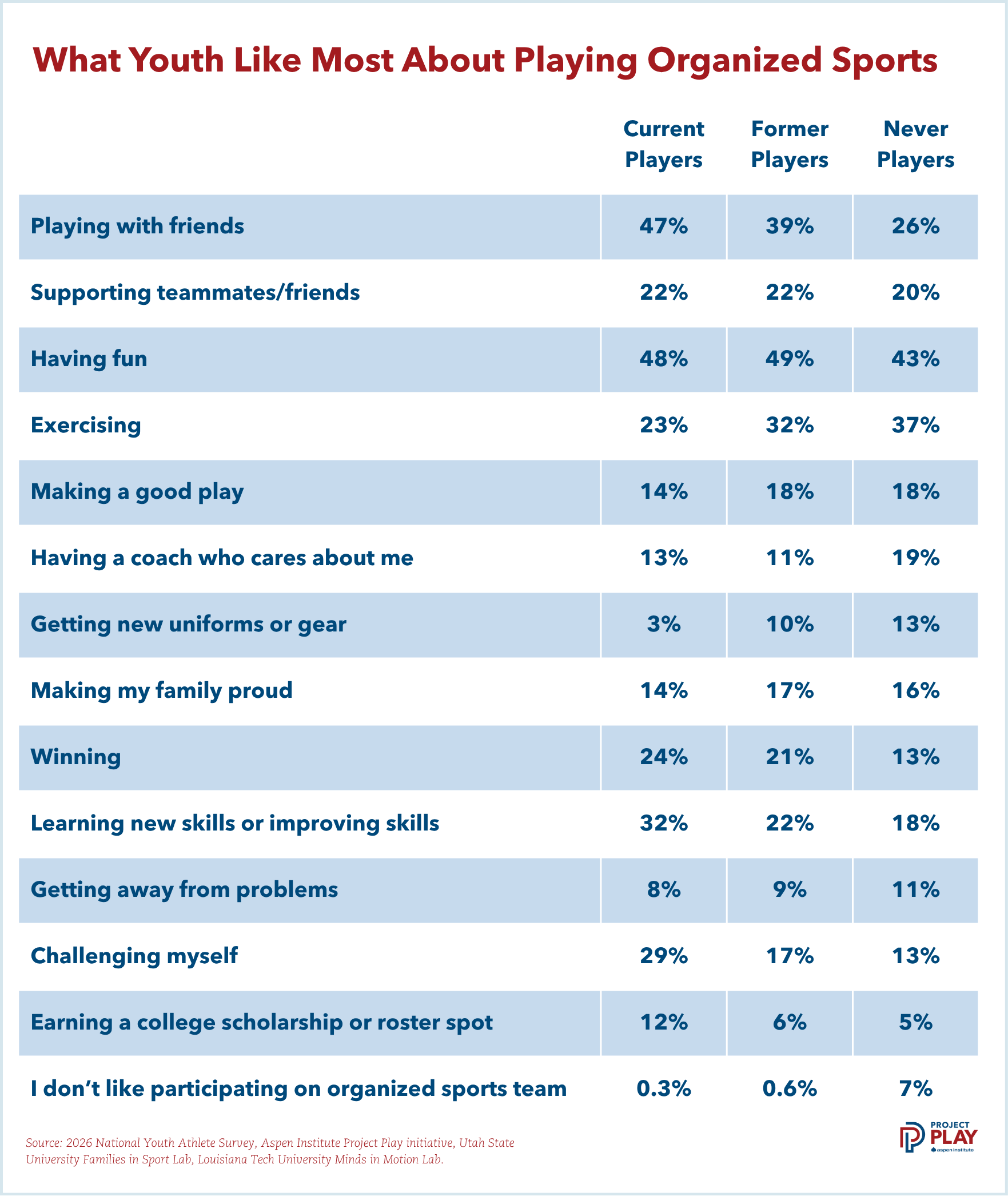
Perhaps most importantly, having fun and playing with friends are by far the top reasons children and adolescents play sports — motivational factors that sit in contrast to the messages often sent by an increasingly commercialized youth sports system that prioritizes winning and the lure of college athletic scholarships.
Those are among many findings from a new study that hears directly from children across the U.S. about their sports experiences. The Aspen Institute, Utah State University and Louisiana Tech University explored why children participate in sports, quit sports or never start in the first place. Analysis of survey results was conducted from three types of children ages 10-17 related to organized sports participation — described in this article as current players, former players and never players.
To reach the federal government’s goal of 63% of children participating in organized sports by 2030, it’s critical to both recruit and retain youth athletes. That requires understanding different perspectives from current, former and never players. What characteristics of sports and broader systemic issues influence their experiences and decisions to play or not play? Here are 15 key findings from our exclusive survey, along with some quotes from former, current and never players who took the survey.
1. Parent behavior is a strong predictor of children continuing sports or dropping out
Finding
There’s a distinct line between the parental behaviors experienced by kids who stay in sports versus those who quit, revealing that former players faced both higher negative pressure and significantly lower positive involvement.
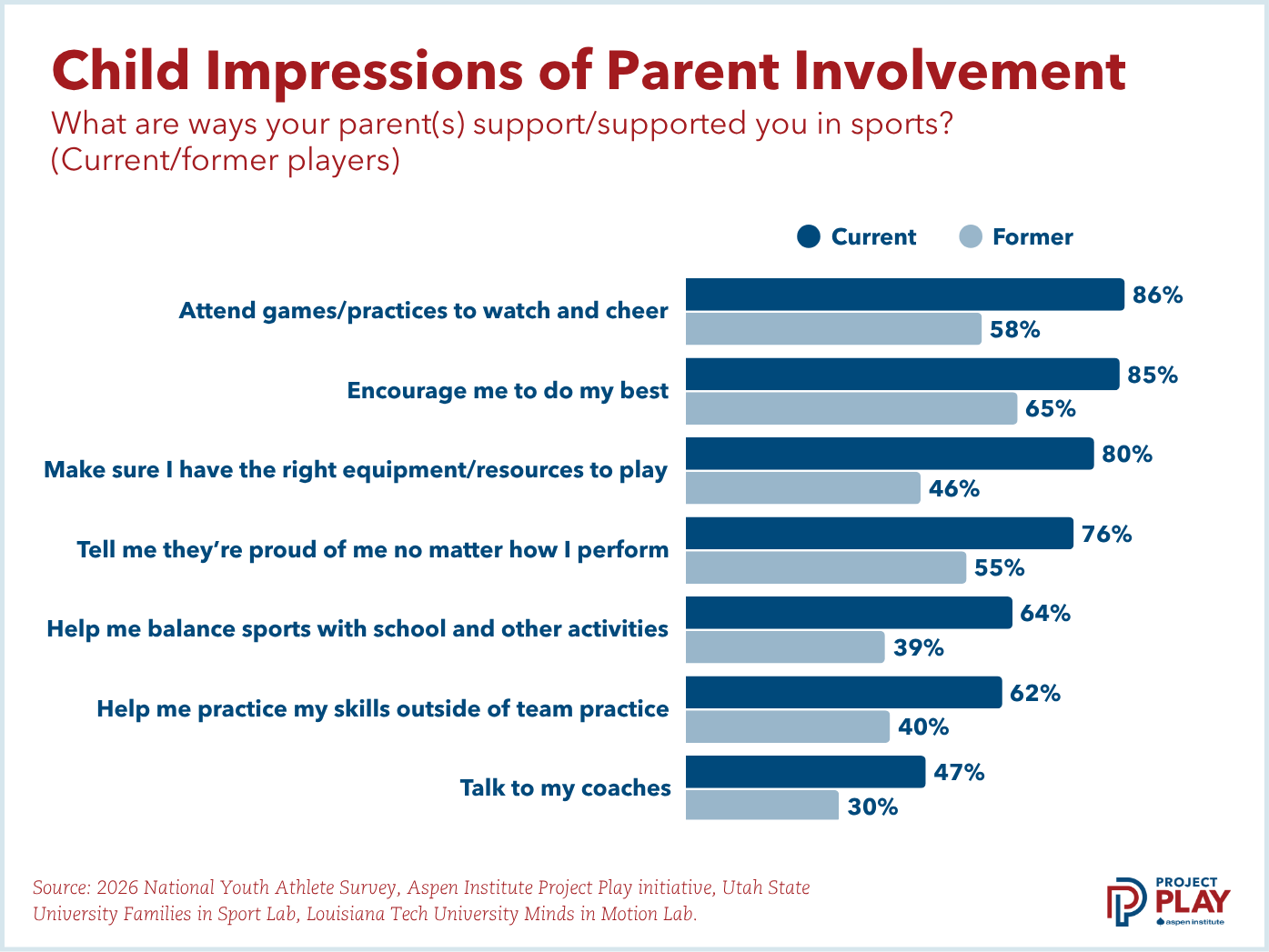
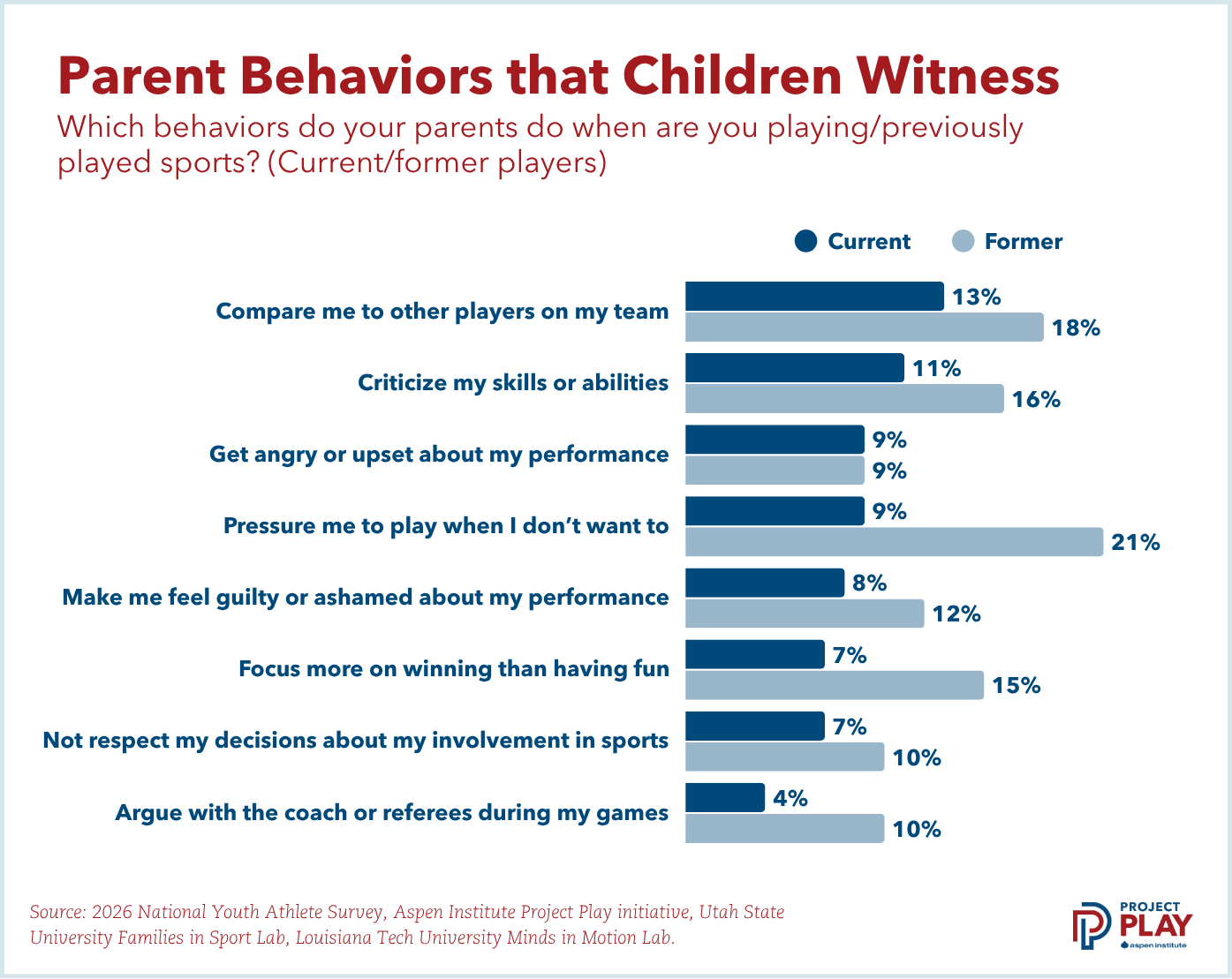
Negative Pressure: Former players reported much higher rates of negative parental behavior when they played, such as being pressured to play when they didn't want to (21% of former players vs. 9% of current players) and being compared to other players (18% of former players vs. 13% of current players).
Lack of Positive Support: Kids who quit sports experienced a steep drop-off in foundational support and capacity from their parents. While 86% of current players have parents who attend their games or practices, only 58% of former players had that same support. This discrepancy in positive involvement spans across all categories of support: current players were far more likely to have parents who encouraged them to do their best, made sure they had the necessary equipment to play, told them they were proud regardless of performance, and helped them balance sports with schoolwork.
““I think my parents didn’t anticipate the amount of time and money it takes to be really, really good in this sport.””
Why this matters
Adult behavior and capacity impact youth retention. A toxic combination of high negative pressure (criticizing skills, forcing participation) and a lack of foundational, logistical and emotional support is associated with youth abandoning sports entirely. Also, decreasing parent involvement — often for understandable reasons like excessive sports costs and job/family responsibilities — plays a role in kids quitting.
2. More girls quit when their parents engage in toxic sideline behaviors
Finding
Girls who quit sports report experiencing significantly higher rates of negative parental behavior than boys who quit. Female former players were roughly twice as likely as male former players to report that their parents compared them to other players (25% vs. 9%), pressured them to play (24% vs. 16%), and argued with coaches or referees during games (13% vs. 6%). Also, 18% of female former players said their parents focused more on winning than having fun, compared to 11% of male former players.
WHY THIS MATTERS
As college and professional sports opportunities increase for females, so does the pressure on girls at younger ages. Sideline culture, critical comparisons and high-pressure parenting are acting as a major deterrent for girls. Decades of research show that girls tend to be more sensitive to social evaluation and relational approval in sport, so when the sideline turns critical or combative, the cost to their motivation is higher. More opportunities for females in sports won't matter much if the youth experience drives them away before they ever get there.
3. Basketball players report the highest negative parent behaviors
FINDING
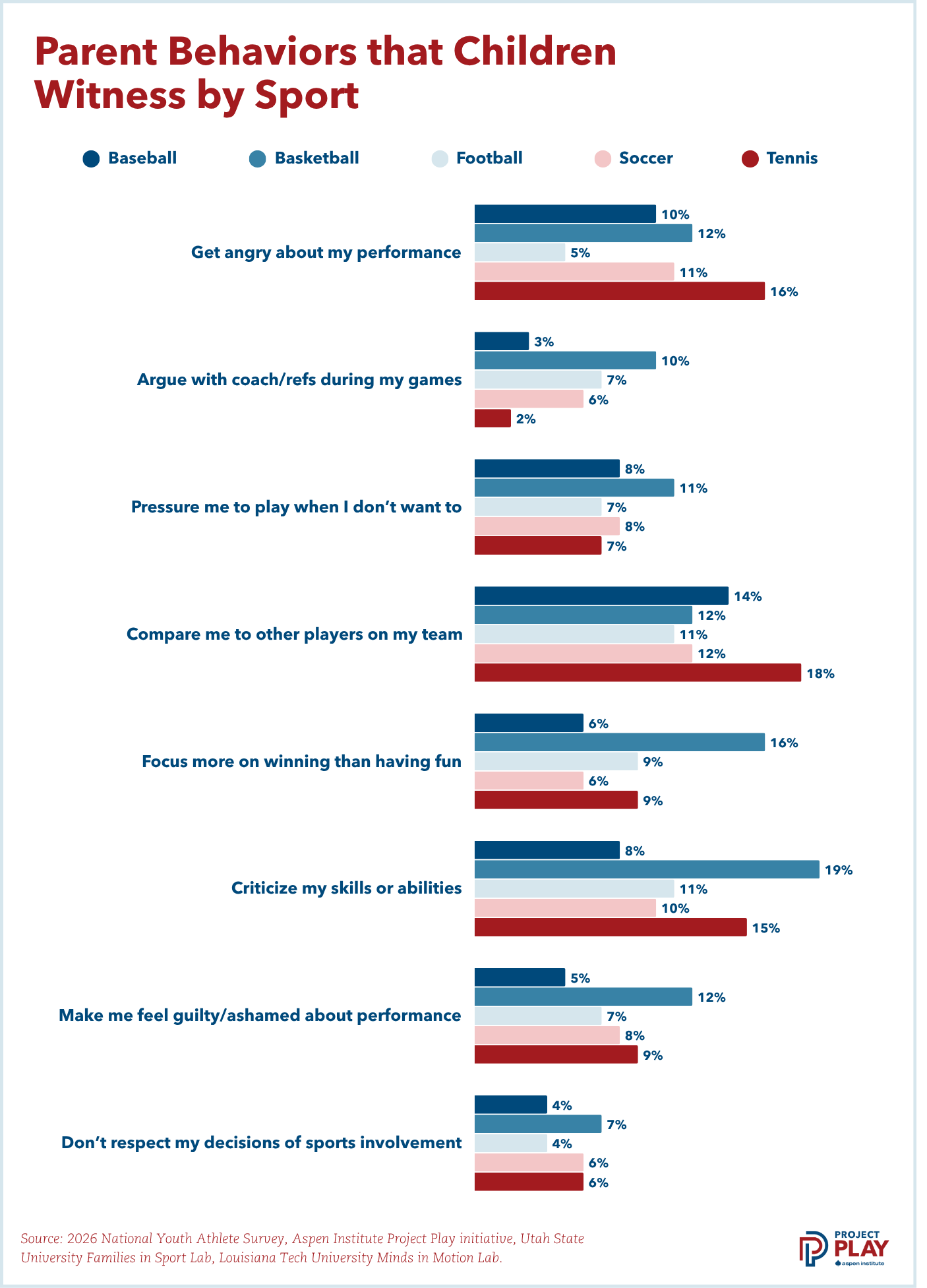
The negative behaviors driving kids away from sports manifest differently depending on the sport. Among the five sports analyzed from the survey results, current players in basketball report the highest negative parent behavior in six of eight categories: argue with coaches/refs, pressure their child to play, focus more on winning than fun, criticize their child’s skills, make their child feel ashamed about their performance, and don’t respect their child’s decisions around sports involvement. Meanwhile, soccer players report the highest rates of parents getting angry/upset about performance (16%) and comparing them to others (18%). Negative perceptions of coaches also vary by sport. Current baseball players report the highest rates of disliking their sport due to “bad coaching” (33%), followed closely by football (30%) and basketball (29%), compared to much lower rates in soccer (20%) and tennis (20%).
Why This Matters
The culture problems in youth sports are often sport-specific. This means National Governing Bodies (NGBs), leagues and coaches can craft parent education and culture interventions that speak directly to what their sport actually needs, rather than generic messaging that fails to land because it doesn’t feel relevant to anyone in particular.
4. Elite sports achievement is a secondary motivator
Finding
The youth sports industry frequently markets the dream of elite achievement, but it does not reflect the primary motivation of most players. Only 12% of current players say "Earning a college scholarship or roster spot" is one of their favorite things about playing. Instead, intrinsic and social motivators dominate: "Having fun" (48%) and "Playing with friends" (47%) are far and away the top priorities.
““I stopped (playing sports) because it just started taking over everything. Between practice, travel games and school work, I barely had time to breathe. I missed hanging out and just being a normal kid.””
Why this matters
There’s a major disconnect between how youth sports are sold and why kids actually show up. Clearly, there is marketplace demand for gaining access to college sports opportunities. A recent survey by IMG Academy found 83% of families want colleges to create more roster spots. Even high school roster spots are a motivator; in a separate 2024 Aspen Institute survey, more than half of sports parents felt the pressure for their child to specialize in one sport was appropriate to help them participate in high school sports. Clubs, parents, coaches and youth sports marketers would be wise to listen to what most young people want from a sports experience and create programs that prioritize joy, community and personal challenge.
5. Fear of injury is a barrier for non-players, older youth and girls
Finding
The risk of getting hurt is a massive deterrent, but primarily for youth who are outside the sports system. A staggering 52% of youth who have never played say the risk of injury would keep them from choosing to play, compared to 27% of former players and just 3% of current players. This fear intensifies as kids grow up; among non-players, 54% of 14-17-year-olds cite injury risk as a barrier, compared to 37% of 10-13-year-olds. These fears disproportionately affect females who have never played (55% vs. 50% for males) or who quit (32% vs. 20% for males). When non-players avoid specific sports due to injury risk, basketball (19%) and tackle football (19%) are the most frequently avoided.
Why this matters
Injury fear is highest among people who have never played and drops substantially once someone is actually inside a program. That gap, between what people fear from the outside and what participants actually experience, is a communications and first-contact challenge for every sport program in this country. To attract the “never played” group, especially older teens and girls, youth sports providers must actively create, market and fund lower-contact alternatives (such as flag football) and visibly prioritize injury-prevention protocols to make entry into sports feel physically safe.
6. Feeling “not good enough” to play sports drives attrition
Finding
When examining why kids quit sports (former players) and what current players dislike most, coaching and confidence are massive factors. “Bad coaching” is the top complaint for current players (23%). For former players, feeling “I’m not good enough” (29%) and “Bad coaching” (21%) were the top two least favorite things about their experience.
““I never felt confident enough to try. Everyone else seemed faster or stronger and I didn’t want to embarrass myself. I didn’t feel like I fit in.””
Why this matters
This highlights a major retention crisis centered on adult behavior and environment. There’s an urgent need for coach training that focuses on youth development, emotional support and skill-building for all levels, rather than just catering to elite players.

7. Public facilities and schools are key to capturing “never played” youth
Finding
Current players are highly integrated into the pay-to-play model, frequently utilizing private sport facilities (49%) and traveling outside their community (30%). However, youth who have never played have entirely different preferences. If they were to join a sport, they most want to play at public sport facilities (47%) and at their school (45%), showing far less interest in private facilities (30%) and almost no interest in travel sports (8%).
Why this matters
To reach inactive and non-participating youth, the youth sports industry cannot rely on the private club model. Investments in public parks and recreation departments and school-based programs are the vital, non-intimidating entry points needed to engage this untapped demographic.
8. School infrastructure is a lifeline for Black players
Finding
The environments where youth play sports differ drastically by race, with school programs serving as the primary setting for Black youth. In the survey, 70% of Black current players report playing sports at their school versus 42% of White players. White players are more heavily integrated into the pay-to-play travel circuit, with 35% reporting they play outside their community, compared to just 20% of Black players.
Why this matters
The pay-to-play travel circuit carries costs in time, money and access that simply aren't feasible for a large share of families. School programs fill that gap, and for kids who depend on them. When those programs get cut or underfunded, the impact falls hardest on Black youth, who are less reliant on a private club or travel team to fall back on. Decisions about school sports funding are also decisions about who gets to play at all.

9. Addressing safety risks is key to getting many Latino/a youth into the game
Finding
Nearly a third (30%) of all Latino/a youth have never played organized sports, which is vastly higher than the non-participation rates of Black (15%) and White (9%) youth. Safety is a massive barrier for this demographic: 55% of current Latino/a players say the risk of injury has kept them from choosing to play a specific sport, compared to just 21% of White and 24% of Black current players.
Why this matters
To effectively engage Latino/a youth and their families, youth sports providers cannot just rely on traditional marketing. They must directly address parental and players safety concerns, emphasize injury-prevention protocols and create culturally resonant, lower-risk entry points into play.
10. The sports drop-out peak occurs during early adolescence (ages 12-14)
Finding
The survey data pinpoints exactly when youth are most likely to walk away from sports. The average age that former players stopped participating is 12.93 years old. Over a third of all youth who quit do so during the three-year window of ages 12, 13, and 14 (11%, 13%, and 10%, respectively). Boys (age 12.4) quit sports at earlier ages than girls (age 13.30). Among former players who stopped playing organized sports at the critical ages of 10-13, Black youth (60%) left at much higher rates than Latino/a (48%) and White (34%) youth.
““(I would play sports again) if the atmosphere was less serious, more about friendship and having fun instead of competition. Maybe a small community team or a mixed group where everyone just enjoys the game.””
Why it matters
This finding highlights a critical retention cliff that aligns with the transition into middle school and high school. Community leaders, schools and leagues need to focus their retention strategies, alternative play models and funding on the vulnerable young teen demographic before they age out of the system.
11. Children believe all players should play and value coach mentors
Finding
Competing matters to most young people but not if it means peers don’t get to compete. A combined 57% of current players believe that either “ALL players should receive time” (40%) or “EQUAL time should be given” (17%). Only 11% of current players and 8% of former players believe that “Only the very BEST players should receive time in games.” When asked to rate the role of their coach on a 1-to-5 scale, current players prioritize development over victories. They strongly agree that a coach’s role is to “Teach us sports skills” (4.69 average) and “Develop our life skills” (4.39 average), rating both significantly higher than “Win games and competitions” (3.90 average).
““My friends on the team kept me going. We’d laugh, complain and push each other. It made all the early mornings worth it.””
Why this matters
This finding pushes back against the exclusionary culture prevalent in many travel and school programs. Kids want their peers to get in the game, an insight that should give leagues the data-backed permission to mandate inclusive playing-time rules. The value of coaches as mentors also provides actionable evidence that coaching education programs need to heavily invest on pedagogical skills, emotional intelligence and life-skill mentorship rather than just game strategy and winning.

12. Winning is valued least by the kids who need sports most
Finding
While 24% of current players cite "Winning" as a favorite aspect of sports, only 13% of youth who have never played say that winning would motivate them to start. Similarly, only 5% of non-players care about earning a scholarship. Instead, the untapped market of non-players is entirely motivated by intrinsic and health factors: they overwhelmingly just want to "Have fun" (43%), "Exercise" (37%), and "Play with friends" (26%). Also, 81% of current players say their mental state gets better when playing, and 84% say their social connectedness improves. Importantly, 68% of youth who have never played believe their mental state would improve if they did, and 74% believe their social connections would improve.
““Finding a sport that aligns with my interests, like hiking or yoga (would convince me to begin playing sports). And for someone to actually believe me that I could or would do it.””
Why this matters
This finding exposes a critical flaw in how sports are advertised to beginners. Programs designed to attract non-players and older beginners will fail if they emphasize tournaments, elite teams or college pathways. Sports providers must create and market low-stakes, intramural-style leagues that explicitly de-emphasize winning and prioritize social connection and physical health. Hearing the value of sports directly from children provides a powerful advocacy tool. Youth who aren’t playing know they are missing out on mental and social benefits, including a strong demand for inclusive sports programming.
13. Video games can be a catalyst for sports participation
Finding
While screen time is often blamed for youth inactivity, the survey reveals that video games actually drive interest in real-world sports. This is especially true for youth who have never played organized sports; a staggering 50% of non-players who game say playing video games makes them more interested in playing sports, compared to just 10% who say it makes them less interested. However, 26% of male former players say video games make them less interested in playing sports compared to 10% of male former players who became more interested in sports through video games.
Why this matters
The traditional narrative is that screens are the enemy of physical activity. There’s more nuance to that line of thinking. The results suggest sports organizations can bridge the gap between digital and physical play, such as using esports as a funnel to introduce non-players to traditional sports. Sports video games, esports and simulation games are building familiarity, aspiration and identity around sports. But are programs meeting kids at that moment of interest, or waiting for them to find their own way into traditional sports on the fields and courts?
14. Physical activity drops as social media time doubles in high school
Finding
The transition from early adolescence into the high school years is marked by a clear decline in movement and a surge in screen time. Youth ages 10-13 report being physically active an average of 5.42 days a week, but this drops to 4.54 days for ages 14-17. Total daily screen time jumps from an average of about 169 minutes for 10-13-year-olds to about 202 minutes for 14-17-year-olds, driven almost entirely by a massive increase in social media use (from 34.27 minutes to 66.18 minutes per day).
Why this matters
While the previous finding showed video games can spark sports interest, the broader aggregate of screen time (especially social media) aligns with a concerning drop in actual physical activity during the older teen years. This finding emphasizes the need to create casual, low-commitment physical activity options specifically tailored to older teens to combat this sedentary shift.
15. Private sport models often exclude low-income youth
Finding
Affluence is directly related to whether a child ever plays sports. Youth from low-income families make up 34% of the entire “Never Played” group, while high-income youth make up only 8% of that group. For the low-income youth who do manage to play, they are heavily dependent on their school (58%). High-income players are heavily concentrated in the club sport ecosystem, predominantly using private sport facilities (51%) and traveling outside their community (38%).
Why this matters
The privatization and travel-team model of youth sports is actively exclusionary. If the industry's goal is to increase overall participation, funding and focus must be redirected toward free, school-based and local public park programs since the private club model almost entirely misses lower-income families.
We want to hear from you.
What innovative youth sports models are successfully addressing any of the challenges highlighted in these survey results? If you lead one of these programs, please fill out this brief survey. Project Play may contact you later to learn more for possible future content.
Survey Methodology
The Aspen Institute’s National Youth Athlete Survey, in partnership with Utah State University and Louisiana Tech University, utilized a survey with a national cross-section of 3,827 youth ages 10-17 from all 50 states and the District of Columbia. The survey oversampled children who self-classified as current players (69%) compared to former players (18%) and those who have never played (13%). Hosted and distributed by Qualtrics International and Resonant Education, survey responses were collected online between October 1 and December 1, 2025. More information about the study’s methodology and demographics are available in the full survey results report.
The Aspen Institute utilized AI through NotebookLM to review the completed report and identify themes relevant to Project Play's mission. AI played no role in analyzing survey data or producing statistical findings. Analyses were conducted entirely by humans at Utah State University and Louisiana Tech University. All article content was reviewed and edited by humans prior to publication.
Jon Solomon is Research Director for the Aspen Institute Sports & Society Program. Email him at jon.solomon@aspeninstitute.org.