

10 Youth Sports Trends to Watch
The ecosystem of youth sports and recreation is constantly evolving. The Aspen Institute’s Project Play initiative identified 10 trends to watch in 2026.
1
How high can youth sport costs go?
The average U.S. sports family spent $1,016 on their child’s primary sport in 2024, a 46% increase since 2019, according to the Aspen Institute’s parent survey in partnership with Utah State University and Louisiana Tech University. That’s twice the rate of price inflations in the U.S. economy during the same period. Driving up the costs are higher spending on team registrations, travel and lodging for non-local play, and individual camps and private instructions to improve athletic skills. Baseball was the most expensive of the three most popular sports, costing more on average than soccer and basketball.

The study came before President Donald Trump’s tariffs and the federal government shutdown, both of which could impact the economy and how families view their child’s sports costs. In 2024, $6.27 billion worth of sporting goods imported into the U.S. came from China, accounting for 61% of these imports, according to ESPN.
Sports & Fitness Industry Association CEO Todd Smith expressed concern that tariffs may slow sports participation and physical activity for the most vulnerable Americans – those households earning less than $25,000 a year. After the 2017 tariffs, those households’ physical inactivity rates went from 45% to 47% in one year. Smith told ESPN it was directly related to the tariffs.
“We, as an industry, sports and fitness offer a free remedy to try and minimize healthcare costs,” Smith said, “so why would we create more barriers to accessibility and entry into activities?”
Nike, Adidas, Under Armour and Puma were among 76 companies that in April 2025 wrote a letter asking Trump for a footwear exemption from reciprocal tariffs. The letter from the Footwear Distributors & Retailers of America warned that tariffs would “become a major impact at the cash register for every family.”
Even before tariffs, it was not just parents feeling the impact of higher costs to play sports. Children notice too. Increasingly, Project Play’s youth surveys in communities across the country show more children saying that what they dislike most about sports is that it’s too expensive. One student told The New York Times he used to play on a team that cost $500 to $700 per month. “A lot of time I would feel pressure to make sure I do well because it costs so much money and if I played badly my parents would be disappointed in how much money we’re investing into the sport for me.”
Global spending on youth sports, which fell sharply in 2020 when the pandemic began, reached record levels by 2023 with the U.S. accounting for most of the rebound, according to Matthew Gravelle for Youth Sports Business Report. After pandemic lockdowns resulted in contraction within youth sports, consumer demand led to a rapid rebound that made the industry more monetizable than before COVID.
Parents demonstrated a greater willingness to spend on organized youth sports. The business model has grown larger and attracted significant capital from private equity firms.
“This change in parental spending behavior has translated directly into more stable revenue streams for clubs, tournament operators, camps, and specialty service providers such as private coaches and skills academies,” Gravelle wrote.
How families and sports providers handle these rising costs and the economy will be important to watch in 2026. Why does it matter? Achieving the federal government’s goal of 63% youth sports participation by 2030 could save the U.S. $80 billion in direct medical costs and productivity losses and deliver over 1.8 million more quality years of life to Americans, according to a study published in the American Journal of Preventive Medicine.
2
Can the Children’s Bill of Rights in Sports create shared expectations?
Adoption in 2025 by the U.S. Conference of Mayors, National League of Cities and National Recreation and Park Association lays the groundwork for using the Bill of Rights as a guiding framework to anchor our youth sports ecosystem in the human rights of children. Developed by the Aspen Institute with a working group of human rights and sports policy experts, the Children’s Bill of Rights in Sports offers eight principles recognizing that all youth should have the opportunity to develop as people through sports.
Municipalities that endorsed the Bill of Rights in 2025 included Tacoma, Washington; Akron, Ohio; Alexandria, Virginia; Perris, California; and Chapel Hill, North Carolina. The cities of Gaithersburg, Rockville and Takoma Park and Montgomery County, Maryland, the 44th most populous county in the U.S., became the first collection of municipalities to make a joint endorsement at a celebration of National Youth Sports Week in October.
“Every child should be able to play in an environment that is safe, supportive and focused on their well-being,” Montgomery County Executive Marc Elrich said. “The Children’s Bill of Rights in Sports reminds us that access, inclusion and respect must guide every youth program we offer in Montgomery County.”
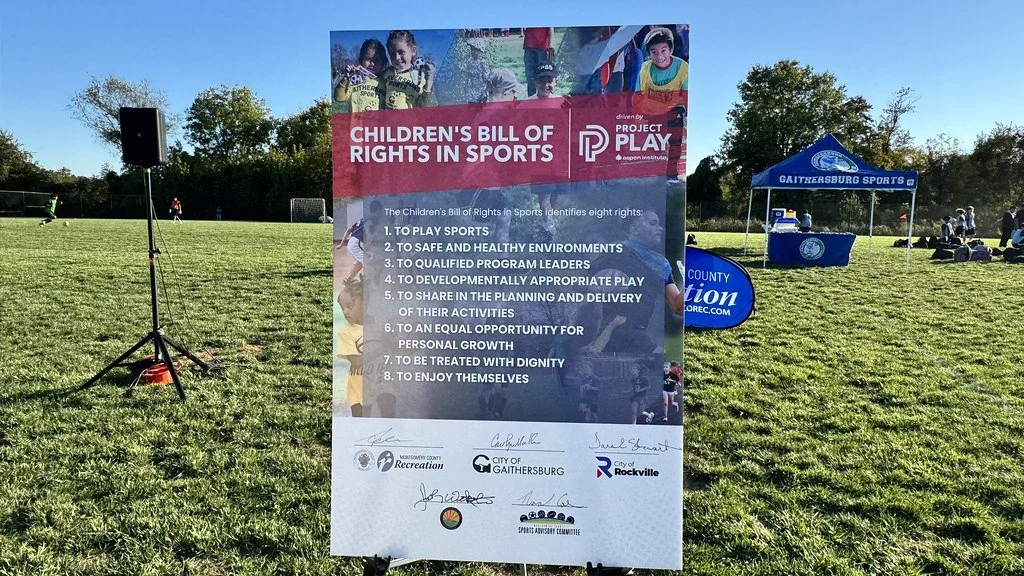
Montgomery County (Maryland) signed on to the bill of rights. (Photo: Montgomery County Recreation)
3
How will NIL change the incentives?
With college athletes now allowed to be paid for their athletic talent through name, image and likeness (NIL) deals, the practice is trickling down to younger levels of sports. And it’s not just high school, where 44 states and Washington D.C. allow NIL agreements for high school students. There are tangible signs that NIL, in some cases, is changing the non-scholastic sports experience for middle school ages and younger.
One example: The New York Times profiled an eighth-grade football player in Washington D.C. who signed sponsorship deals with a local fashion brand and hired an agent for future deals. “The goal is for him to reach a million dollars his freshman year of high school,” the mom said.
Half a dozen players on the child’s middle school football team have secured NIL deals with support of their coach, who dislikes the NIL system but believes he needs to educate players since NIL deals in youth sports are inevitable. The coach teaches players how to open a savings account, brings in a bank representative to talk to parents, and requires students to pass a financial competency test and take lessons in handling social media and the news media. Students who secure NIL deals must maintain a 3.5 grade-point average to play.
Roughly two in 10 youth sports parents believe their child has the ability to eventually play Division I college sports, and one in 10 think their child could reach the pros or Olympics, according to a survey by the Aspen Institute. Adding the potential of NIL money in real-time brings new variables to how families view sports.

Child athletes are being recorded now from the moment they join organized sports. (Photo: Getty Images)
As NIL opportunities grow more lucrative and visible, families are making more strategic choices about where to invest their time and money. Increasingly, that investment is being funneled into three sports – football, basketball and volleyball, Tom Kuhr, senior vice president of marketing at sports operations company Fastbreak AI, wrote in SportsBusiness Journal.
“These shifts reflect the gravitational pull of NIL toward high-exposure, high-earning sports,” Kuhr said. “Parents and athletes are following the money, and the system is starting to consolidate. The new playbook is clear: Pick a sport with a viable NIL pathway, invest early, specialize quickly and aim to stand out in a shrinking pool of opportunity.
“When youth sports collapse into a few dominant categories, we lose more than athletic diversity. We lose access, equity and sustainability. Kids who once had the chance to try multiple sports are now told to pick a lane by age 10. Families who can’t afford the private coaching, tournament travel or recruiting services required to compete are pushed out.”
Will we recognize youth sports in five or 10 years? While NIL will financially help a select group of athletes and their families, could it trigger the downturn of certain sports at the youth level that are not viewed as a viable pathway for NIL deals? Will children specialize in one sport at even younger ages because of the potential of real-time wealth?
4
How will AI reshape youth sports?
Welcome to the data-driven age of youth sports. Using artificial intelligence-powered video analysis, wearable sensors and analytics platforms, sports providers are potentially offering families a more personalized and engaging experience.
But AI also carries concerns about costs, data privacy, balancing technology with personal coaching, and time commitment for younger children. Do we really want 8- and 9-year-old soccer players in film study? Westchester FC in New York offers parents the option of paying $300 annually for their child’s analytics.
“I’m torn by that as well,” FC Westchester President George Gjokaj told NBC News. “Reluctantly, the ecosystem has forced us to start younger and younger to stay in the game. I’d prefer to let them just have fun and support them without taking it too seriously at that young an age.”
AI-powered platforms can analyze individual player performance and biometric data to create customized training programs. Players can also study their specific strengths and weaknesses by tracking metrics like player speed, time of possession and movement patterns. This also provides coaches with statistics to evaluate players that were previously unavailable.
AI is also making advanced training, safety and administrative tools more accessible to young athletes, coaches and league managers. This could help injury prevention. By analyzing biomechanical data and training loads, AI can predict when a player might be at risk for an injury due to fatigue or improper technique.
For league administrators, AI is helping to create game and practice schedules, balance team availability, facility usage and travel logistics. AI-powered platforms can automate tasks like registration form creation, communication management and evenly distributing players across teams based on age or skill level.
Some worry that relying too heavily on AI-driven insights could dilute the human element and emotional connections central to the coach-athlete relationship. Also, the digital divide is real. The high cost of some AI technologies may only widen the gap between sports programs and athletes who have money and those who are under-resourced.
5
How will SCOTUS rule on transgender athletes?
With heightened scrutiny around transgender participation in sports, the Supreme Court added two cases in 2025 on the subject. Justices are examining if state laws restricting participation in girls and women’s sports to those born female violate the equal protection clause of the 14th Amendment or Title IX. The states involved (Idaho and West Virginia) claim that courts should assess their transgender sports policies using a less stringent legal standard and that the equal protection clause allows sex-separated teams, SCOTUSblog reported. Supreme Court rulings will likely come in 2026.
The Idaho case focuses on the state’s Fairness in Women’s Sports Act, which requires participation on sports teams based on biological sex at birth. The law was challenged by a transgender college student, who secured an injunction from the district court that was upheld by the U.S. Court of Appeals for the 9th Circuit.
In the West Virginia case, a transgender teen challenged the state’s Save Women’s Sports Act, which prohibits individuals identified as male at birth from competing on female teams. The district court initially granted an injunction allowing the teen to play on school teams before reversing its decision, ruling the West Virginia law was constitutional. The U.S. Court of Appeals then overturned the decision and declared that the law violates Title IX, the federal law prohibiting sex-based discrimination in federally-funded education.
Also in 2025, President Donald Trump signed an executive order banning transgender athletes from participating in girls’ and women’s sports, and his administration sued Maine for not complying with the order. “This has been a huge issue for him,” Attorney General Pam Bondi said, according to the Associated Press. “Pretty simple, girls play in girls’ sports, boys play in boys’ sports. Women play in women’s sports, men play in men’s sports.”
The Trump administration has also pursued policy changes related to transgender high school athletes in Minnesota, California and Oregon. In May 2025, the California Interscholastic Federation adjusted its track and field championship rules to allow for an additional competitor in three events after a transgender athlete qualified for the finals.
After Trump’s executive order, the NCAA and U.S. Olympic and Paralympic Committee changed their transgender athlete policies to restrict women’s sports to competitors recognized as female at birth. The USOPC policy change was a reversal after the organization said in April 2025 that it did not plan to decide eligibility criteria for transgender athletes ahead of the 2028 Summer Olympics, and that the responsibilities fell to individual governing bodies.
The New York Times reported it’s unclear how the new USOPC policy will play out by state and sport since states like Minnesota and California oppose Trump’s order. Some sports could add “open” categories available to anyone, or a mixed-gender category to accommodate the policy change.
Among all U.S. youth ages 13-17, 3% identify as transgender (about 724,000 youth), according to estimates by the Williams Institute at UCLA School of Law. Youth 13-17 comprise 25% of those who identify as transgender. LGBTQ youth report playing sports at lower rates than their peers, often due to policies and fear of harassment, according to a study by The Trevor Project.
6
Has pickleball now captured kids?
The number of children ages 6-12 who played pickleball at least once in the past year doubled over a two-year period, reaching 2.2 million in 2024. Teenagers 13-17 increased their pickleball participation by 157% over two years.
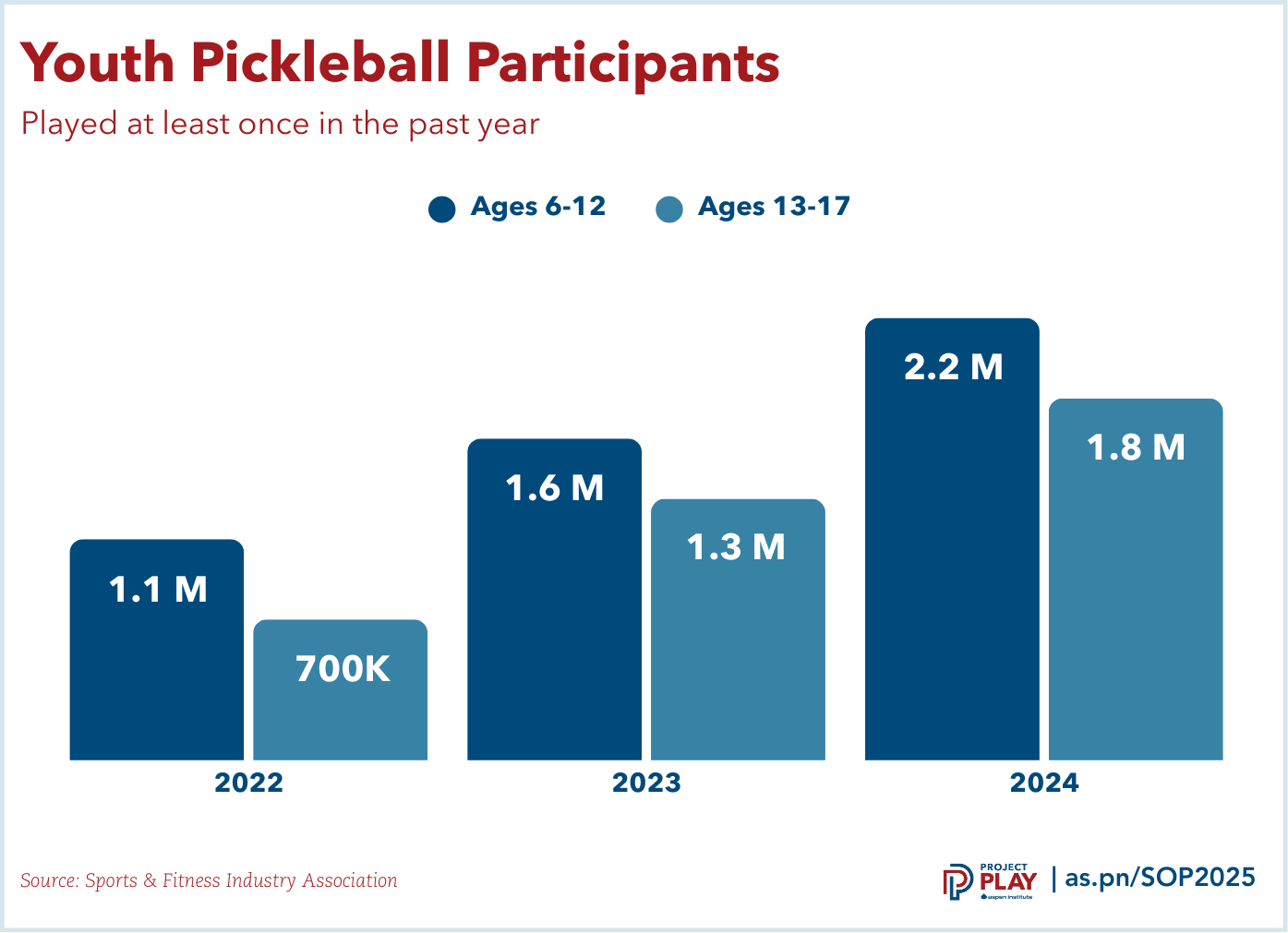
The latest data from the Sports & Fitness Industry Association shows interesting trends:
Boys are playing pickleball more than girls at all ages. At the 6-12 age group, boys are almost twice as likely to have tried pickleball once. The gap is closer at 13-17 – 9% for boys vs. 8% of girls.
Among casual pickleball players, defined as playing one to seven times in a year, children ages 6-17 play at a higher rate than adults ages 45-64.
But older adults are still the most popular core participants, defined as playing at least eight times a year. Adults 65 and older (26%) and ages 55-64 (19%) are far more likely to be core pickleball players than kids 6-12 (8%) and 13-17 (8%).
Still, the sport is growing among children. YMCAs, Boys and Girls Clubs and Dill Dinkers facilities host pickleball lessons and matches. Youth pickleball associations are emerging. Montgomery County, Maryland, the first school district to make pickleball a varsity sport, sent 31 athletes to China in a pickleball exchange trip to build positive relations. And pickleball tournaments for young people are popping up around the country.
“The big thing we’re seeing is the change in the age group,” Southern Pickleball co-founder Mark Spackman told Carolina Reporter about his travels across 10 Southern states for amateur tournaments. “Even four years ago when I started, it seemed like it was mostly 50 and up. But now we’re having players from 8 up, and some of our biggest divisions are 21- to 35-year-olds.”
7
Can all these mega-facilities thrive?
Increasingly, commercial real estate and local economic development officials view America’s expensive relationship with youth sports as a revenue generator. In 2025, Ocoee, Florida approved development of a 159-acre youth sports and hotel complex valued at up to $1 billion.
That’s right – billion. The project is called The Dynasty and there are plans for 17 multipurpose fields, a 150,000-square foot indoor sports facility, more than 1,000 on-site hotel rooms, 350,000 square feet of retail and dining entertainment venues, a riverwalk and parking garages.
Scheduled to open in 2027, The Dynasty calls itself “a revolutionary turning point for youth sports” to create a sustainable future. “The Dynasty Experience is more than a destination for youth and amateur travel sports – it’s a movement, redefining how we train, compete, and play,” the website says. “With professional-grade sports facilities, thrilling entertainment, and vibrant dining and retail options, The Dynasty delivers something for everyone.”
Youth Sports Business Report predicts that by 2030 only two distinct tiers of sports offerings will be available for families – premium destination experiences like Dynasty and community-based recreational programs. “The middle market of regional tournament facilities faces the greatest disruption risk,” wrote Youth Sports Business Report.
There are cautionary tales of mega complexes. In 2025, the father-and-son creators of the massive Legacy Park complex in Mesa, Arizona, began prison sentences for fraud. The $284 million complex was financed with municipal bonds, and the creators allegedly shared documents that falsely claimed the facility would generate nearly $100 million in revenue during its first year. Instead, the complex generated less than $28 million in Year 1 and was later sold for less than $26 million, leaving bondholders with near-total losses.
8
What’s the role of states in regulating youth sports?
In August 2025, Illinois Gov. J.B. Pritzker signed into law the Illinois Youth Sports Commission, the nation’s first statewide commission focused on quality, access and equity in youth sports. Laureus Sport for Good USA played a major role in creating the commission, whose purpose is to gather and evaluate community feedback and make recommendations around the following:
Creating equitable, safe and sustainable access for youth to play sports meeting their skills and interests
Expanding and integrating positive youth development in youth sports
Promoting and hosting youth sports programs, events and tournaments throughout Illinois
Meanwhile, California Gov. Gavin Newsom signed legislation that could lead to the creation of a department to support and regulate youth sports in his state. The Youth Sports for All Act will seat a commission to study the need for a California Department of Youth Sports. The commission will assess the need and potential for a centralized entity to improve access to sports for all youth, and offer recommendations about the duties, powers and responsibilities of such a department, financial impacts, and potential funding sources.
9
Can the Presidential Fitness Test be revived?
Remember the shuttle run and sit-and-reach in physical education classes? The standardized exercises used to measure students’ physical fitness for more than half a century until 2013 are planned to return thanks to President Donald Trump’s executive order.
"Rates of obesity, chronic disease, inactivity, and poor nutrition are at crisis levels, particularly among our children," Trump’s order reads. "These trends weaken our economy, military readiness, academic performance, and national morale."
The rollout of the test will be administered by Health and Human Services Secretary Robert F. Kennedy, Jr., who has bemoaned rising rates of obesity and physical fitness levels in the U.S. It’s not clear when the test will return or which exercises will be measured.
Educators who spoke with NPR expressed hope that the Presidential Fitness Test will prioritize health-related fitness over specific skills. They would like to see resources provided to help the teachers who administer the test and collect data from it. And they hope the test allows schools to spend more time encouraging kids to develop lifelong active habits, not just how to prepare for the test and pass it.
Getting the fitness test reintroduced could be challenging due to the declining number of U.S. schools offering P.E. in recent decades. Fewer P.E. classes are being offered due to budget cuts, increased pressure for standardized academic test scores in math and reading, and a lack of strong state-level mandates for P.E.
In a new study published in the journal JAMA, researchers found that the health of America's children has significantly worsened across several key indicators since 2007. A U.S. child was 15% to 20% more likely to have a chronic health condition in 2023 than a child in 2011. In particular, the prevalence of obesity, depression, anxiety and sleep apnea all increased.

The Presidential Fitness Test is being reintroduced in an era of fewer P.E. classes. (Photo: Getty Images)
10
How will gambling impact youth sports?
In a responsible move but disturbing sign of the times, Little League International urged fans to not bet on games involving children. While no major sportsbooks offer odds on the Little League World Series, which features children ages 10-12, the same is not true for unregulated, overseas sportsbooks.
The brand manager of one such firm, in its fourth year of offering LLWS odds, told Patch it saw more bets on Little League games than any pro tennis or soccer match over a two-week period in August. BetOnline said it received more than a thousand wagers in the opening hours, causing Little League to sharply condemn all gambling associated with the tournament.
In Cincinnati, gun violence at youth peewee football games has been spurred on by gambling, according to Cincinnati City Councilman Scotty Johnson. Johnson said bets of up to $5,000 are being placed on these youth games.
“Stop betting on our children,” he said. “It’s really up to the people attending those games to not make our children objects.”
This isn't a new phenomenon, just a growing concern. In the Aspen Institute’s 2018 State of Play Mobile County (Alabama) report, 26% of surveyed youth said they had played in a game where adults bet money on who won or the final score. Children who played tackle football, basketball and baseball were by far the most likely to say adults gambled on their games.