+ Graphics Methodology
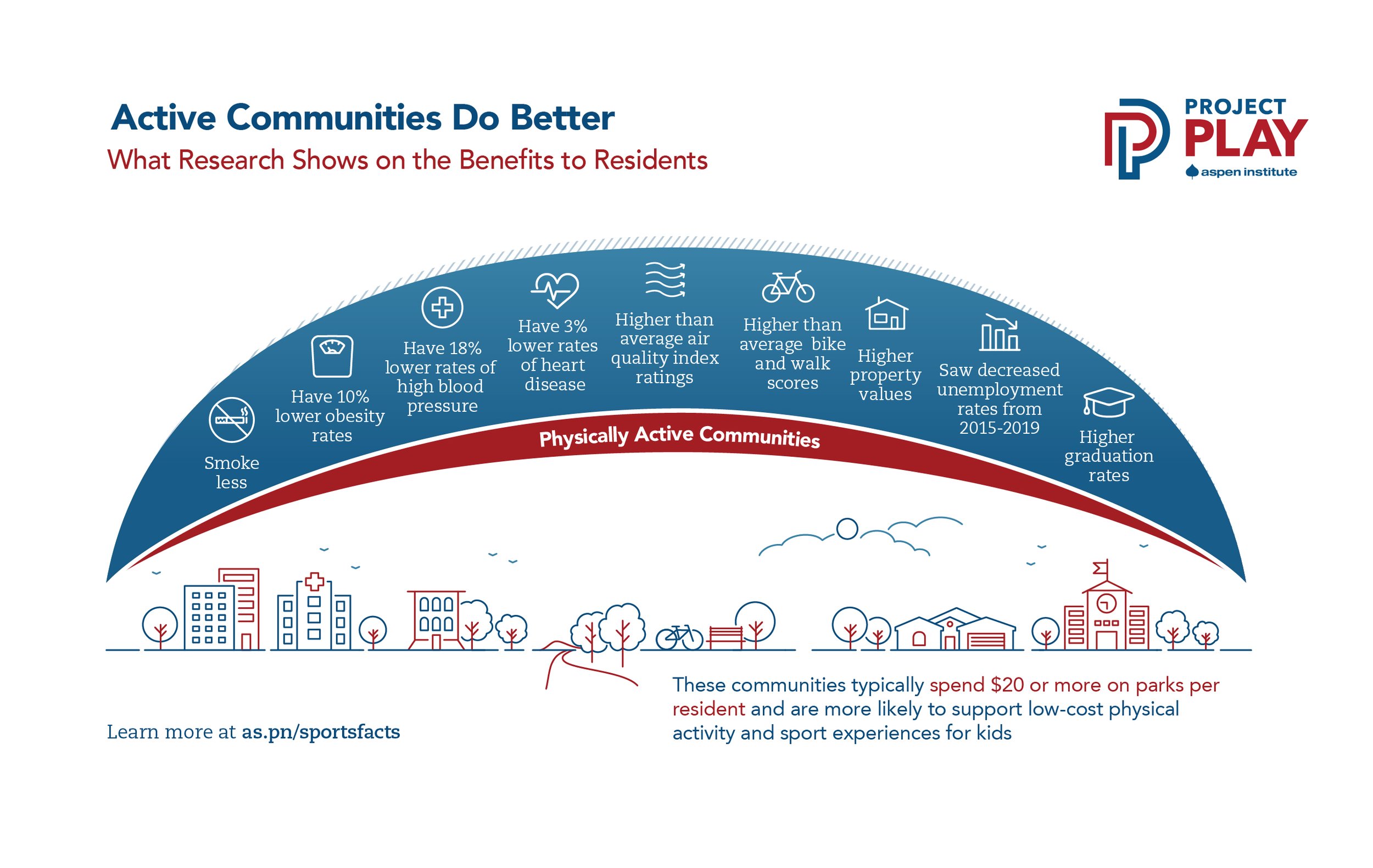
We examined the top 10 cities (overall ranked) in the 2019 ACSM American Fitness Index to understand the values, capital and financial investments, and environments of a community that invests in sport and recreation. The cities with the highest scores are considered to have a strong community fitness, a concept comparable to individuals having strong personal fitness.
+ Graphics Sources
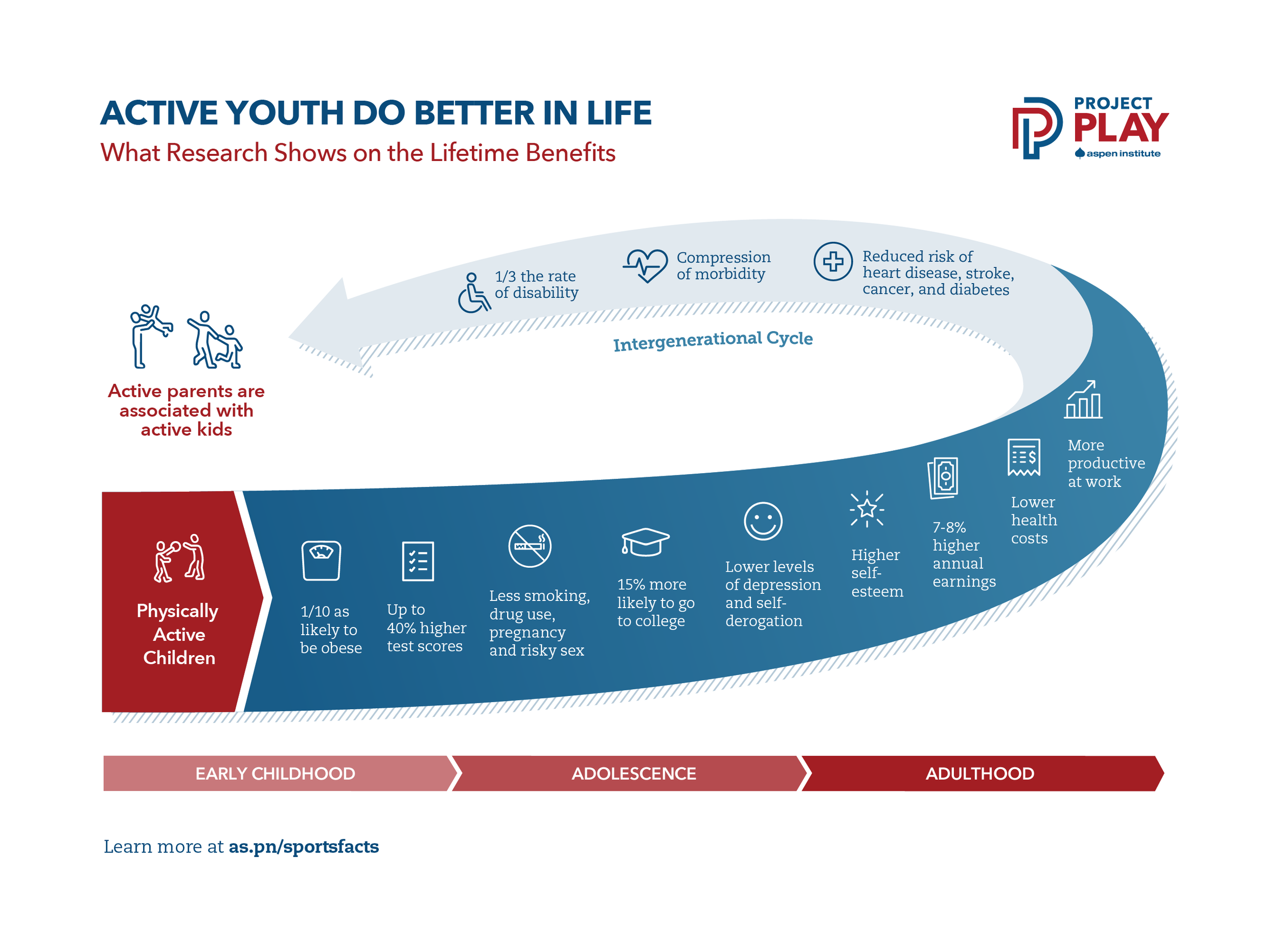
Active Kids Do Better In Life
Ratey, J. J., and Hagerman, E., Spark: The Revolutionary New Science of Exercise and the Brain, Little, Brown & Company, 2014.
Moore, L. et al., “Does early physical activity predict body fat change throughout childhood?,” Preventative Medicine, 37:10-17, 2003.
Grissom, J., “Physical Fitness and Academic Achievement,” Journal of Exercise Physiology, 8(1), 11-25, 2005.
Staurowsky, E.J., “Her Life Depends On It: Sport, Physical Activity, and the Health and Well-Being of American Girls and Women,” East Meadow, NY: Women’s Sports Foundation, 2009.
Jones-Palm, D.H. and Palm, J., “Physical Activity and Its Impact on Health Behavior among Youth,” 2005.
Lieras, C., “Do skills and behaviors in high school matter? The contribution of noncognitive factors in explaining differences in educational attainment and earnings,” Social Science Research, 27:888-902, 2008.
Stevenson, B., “Beyond the Classroom: Using Title IX to Measure the Return to High School Sports,” Review of Economics and Statistics, 92:284-301, 2010.
Cawley, J. and Meyerhoefer, C., “The medical care costs of obesity: An instrumental variables approach,” Journal of Health Economics, 31(1), 219-230, January 2012.
Proper, K.I. et al., “Dose-response relation between physical activity and sick leave,” British Journal of Sports Medicine, 40(2), 173-178, 2006; 2008 Physical Activity Guidelines for Americans, United States Department of Health and Human Services, 2008.
Olshansky, S.J. et al., “A Potential Decline in Life Expectancy in the United States in the 21st Century,” New England Journal of Medicine, 352(1):1138-1145, March 17, 2005.
Fires, J., “Physical activity, the compression of morbidity, and the health of the elderly,” Journal of the Royal Society of Medicine, 89, 64-68, 1996.
Moore, L.L. et al., “Influence of Parents’ Physical Activity Levels on Activity Levels of Young Children,” Journal of Pediatrics, 118(2):215-219, 1991.
Active Communities Do Better
American College of Sports Medicine. (2019, August 17). ACSM American Fitness Index.
Centers for Disease Control & Prevention. (2016, June 3). FastStats. National Center for Health Statistics: Obesity & Overweight.
Centers for Disease Control & Prevention. (2020, February 25). Facts About Hypertension | cdc.gov. High Blood Pressure: Facts About Hypertension.
Centers for Disease Control & Prevention. (2020b, June 22). Heart Disease Facts | cdc.gov. Heart Disease Facts.
National Recreation and Park Association. (2017). The Economic Impact of Local Parks | Research | National Recreation and Park Association. The Economic Impact of Parks: An Examination of the Economic Impacts of Operations and Capital Spending by Local Park and Recreation Agencies on the U.S. Economy.
U.S. Bureau of Labor Statistics. (2019, September 20). Unemployment Rates for Metropolitan Areas. Local Area Unemployment Statistics.
Open Data Network. (2018). High School Graduation Rate Data for Arlington, VA - Graduation Rates on the Open Data Network. High School Graduation Rates.
NPR, Robert Wood Johnson Foundation, & Harvard T.H. Chan School of Public Health. (2017, July 11). Sports and Health in America. Sports and Health in America.